•
Boostiko Team

Futures Prop Firm Checkout Emails: Recover Interest Without Pressure
A futures prop firm checkout email should not feel like a countdown clock yelling at a trader to buy now.
Someone who starts checkout may be comparing plans, checking rules, waiting for a card issue to clear, or deciding that the product is not a fit. They may also have simply left a browser tab open. A checkout event shows interest. It does not prove that the person wants more promotional messages or that they are ready to make a decision.
That is why good futures prop firm email marketing uses checkout emails to make the next step clear. It gives the person a path back to the correct page, answers the basic questions, and offers support. It does not pretend that buying an evaluation or trading a futures account will lead to a specific outcome.
This article is general marketing and operations guidance. It is not legal, financial, trading, or regulatory advice. Each firm needs qualified review of its product terms, payment wording, pricing, promotions, eligibility rules, disclosures, permissions, and messages before anything goes live.
Treat checkout activity as a status, not a promise
A checkout started event is useful. It tells the team that a person reached a certain point in the buying path. It does not say why they stopped.
The difference matters. If an email says “Your payment failed” but the system only knows that checkout was opened, the message may be inaccurate. If it says “Your account is waiting” when the person has not agreed to the terms or finished a required step, the message may create confusion. A clear lifecycle begins with accurate events.
For a futures prop firm, keep the event names plain and controlled:
checkout opened
plan selected
checkout submitted
payment approved
payment issue received from the approved payment system
evaluation account created
refund, chargeback, cancellation, or support state
email permission changed
These are not customer facing labels. They are the conditions that decide whether a message can be sent, which template is relevant, and when the flow must stop.
The checkout platform, payment provider, and account system should have defined owners. Every event needs a source, a timestamp, and a documented meaning. If payment data arrives late or twice, the email system should not send duplicate reminders.
Keep the first email simple
The first message should arrive only when it reflects a real checkout state and the person is eligible to receive it. Its job is not to overcome every objection. Its job is to help the reader return to the correct page or get assistance.
A safe structure is short:
Subject: Need help finishing your checkout?
You started a checkout for a futures evaluation. If you want to continue, return to your secure checkout page. If you have a question about plan details, account rules, or a technical issue, our support team can help.
Primary action: Return to secure checkout
Secondary action: Contact support
This copy does not state that a trading opportunity will be missed. It does not imply that a customer is likely to pass an evaluation. It does not add performance claims. It gives the reader two practical options.
The most useful details must come from the approved product source. If the checkout shows price, plan terms, reset options, evaluation rules, billing frequency, or regional availability, the email should link to the relevant approved page rather than trying to restate complex conditions in a small promotional block.
Do not use pressure as a substitute for clarity
Futures prop firm marketing can get aggressive quickly. The usual pressure lines are familiar: “Do not miss your chance,” “Start earning today,” “Get funded fast,” or “This is your last shot.” These lines may not match the real customer journey, and some create unnecessary compliance risk.
NFA Compliance Rule 2-29 prohibits high-pressure approaches in communications related to commodity interest business by covered members and associates. It also prohibits promotional material likely to deceive and says that profit references need an equally prominent discussion of risk of loss. 1
Not every futures prop firm has the same legal structure or regulatory status. That does not make pressure a good business practice. Use an internal review process that treats these points as a baseline:
no claim that trading is right for everyone
no suggestion that a person is likely to profit or pass
no future result implied by prior outcomes or testimonials
no fake deadline or scarcity message
no edited screenshot that hides material conditions
no approval message until the relevant account state is true
Urgency is only acceptable when it is factual, current, approved, and relevant to the exact recipient. If an offer really expires at a defined time, say what expires, when it expires, who is eligible, and where the person can review the full terms. If that information is not clear, leave the urgency out.
Build a short checkout sequence with stop rules
A long series of checkout emails may increase complaints, confuse support, and hurt sender reputation. A better approach is a short sequence where each message has one purpose and a reason to stop.
Email one: return to the correct checkout page
Trigger: A person started a checkout but has not reached a final payment or account outcome after a reasonable delay.
Goal: Give a secure return path and a support option.
What to include: The product category, a direct secure link, a short note that terms and eligibility are available on the checkout page, and support contact details.
Stop rule: Stop as soon as the checkout becomes paid, cancelled, refunded, charged back, in a support process, or ineligible for marketing.
Avoid product claims here. A checkout reminder does not need a market forecast, a motivational speech, or a long list of features.
Email two: answer the common questions
Trigger: The person remains in a permitted checkout state and did not return after the first message.
Goal: Reduce avoidable friction.
What to include: Links to approved FAQs about plan selection, platform access, rules, billing, support hours, or technical requirements. Use the current published pages, not a copied summary that may go stale.
Stop rule: Stop when the person returns, pays, contacts support, changes preference, or hits the frequency cap.
This email is especially useful when the most common blockers are basic. Customers often need a way to compare an evaluation path, understand a rule, or contact a human. Help them find the answer. Do not turn an FAQ into a promise of funding, payouts, or trader results.
Email three: factual expiry notice, only when true
Trigger: There is a real, approved deadline that applies to the recipient.
Goal: State the deadline accurately.
What to include: The precise end time, time zone, eligibility terms, a link to full conditions, and a clear support route.
Stop rule: Stop when the deadline passes or any conflicting account state occurs.
A real deadline can be useful. A fake timer is not. If the offer is available again next week, do not write “last chance.” If the person is excluded by location, payment method, or prior purchase, the message should not go out.
Keep checkout and account opening separate
Buying an evaluation product and opening a regulated futures account are not the same account state. A checkout email must not suggest that all trading access, disclosure, or suitability steps are complete unless the approved account system confirms it.
For example, 17 CFR § 1.55 requires a futures commission merchant or introducing broker covered by the rule to provide a separate written risk disclosure and obtain a signed and dated acknowledgement before opening a commodity futures account for a non-institutional customer. 5 A marketing email can direct the customer to the approved account experience. It should not rewrite, minimize, or bury required disclosures.
Email four: human support follow up
Trigger: A defined operational event indicates that support could help, or a customer asked for help.
Goal: Close the loop on a real question or technical issue.
What to include: A factual explanation of the next support step and an authenticated route to the account or help center.
Stop rule: Stop when the issue is resolved, the ticket is closed, or the customer moves to a different account state.
Do not make a support email a disguised campaign. If the subject says it is about an issue, the body should solve the issue. Promotional content can make customers distrust the message and may change the message classification.
Separate marketing from account and support notices
The primary purpose of the email matters.
The FTC says CAN-SPAM covers commercial messages whose primary purpose is advertising or promoting a commercial product or service. Its guidance calls for accurate routing information, subject lines that reflect the content, a clear way to opt out, and prompt handling of opt-out requests. 2
A firm should decide the message type before it selects a template:
Marketing email: promotes a product, offer, or purchase decision. It needs the appropriate permission, suppression checks, disclosures, and unsubscribe handling.
Account or support notice: gives information about a current account, request, or technical issue. It should stay focused on that task.
A small sales block can turn a practical account notice into a marketing message. For example, an email about a checkout issue should not suddenly add a new promotional offer. Keep marketing and support journeys separate in the event map, audience rules, and reporting.
Permission and suppression are part of the checkout flow
A person reaching checkout does not erase privacy choices. The firm must apply the permission rules that are relevant to the customer and market.
For individuals in the UK, the ICO says marketing emails generally require specific consent, subject to a limited soft opt-in for existing customers who were given a simple opt-out when their details were collected and in each message. The ICO also says senders must not conceal their identity and must provide a valid contact address to opt out or unsubscribe. 3
The operational lesson is simple. Store the source of permission, the date, the jurisdiction or audience rule, and the latest preference change. Before every marketing send, screen out people who opted out, complained, hard bounced, refunded if policy requires suppression, or entered a conflicting support state.
Do not use a checkout export as a separate marketing list. Use one customer profile with one permission record and one suppression process. If a person opts out from marketing, that change must reach the email platform quickly.
Protect the inbox before scaling reminders
Checkout emails sit close to a purchase decision, so it can be tempting to send them often. Frequency has a cost. Repeated messages that the customer does not want can raise spam complaints and damage the reputation of the sending domain.
Google requires SPF or DKIM for all senders to personal Gmail accounts. Bulk senders need SPF, DKIM, DMARC, aligned From domains, one-click unsubscribe for marketing and subscribed messages, and spam rates below 0.3% in Postmaster Tools. 4
Build those controls before pushing volume:
authenticate the domain used in the From address
keep marketing and operational streams distinct where appropriate
apply unsubscribe, hard-bounce, and complaint suppression before sending
use a stable sender name customers can recognize
cap message frequency by person, not only by campaign
pause or reduce messages when complaints or negative support signals rise
test all links and account routing on mobile before launch
The email program should be able to explain why any recipient received a reminder. If the team cannot answer that question from the customer record, the automation is too loose.
Use measurable rules, not vague conversion goals
A futures prop firm checkout flow should be measured by the health of the journey, not only by gross checkout value.
Track the following with the correct definitions:
checkout starts that receive a permitted email
return visits to the secure checkout page
support requests after each template
payment completions that occur after a valid return path
cancellations, refunds, chargebacks, and complaints by entry point
unsubscribes, hard bounces, and spam complaints by message
duplicate sends prevented by stop rules
time from checkout event to a final account outcome
Review these results alongside support, compliance, product, payments, and operations. A message that creates more inbound questions may reveal unclear checkout information. A message that generates clicks but also drives complaints is not a clean win.
Do not attribute every later payment to an email. Checkout is a multi-step decision. Use a documented attribution model and keep the raw account events available for review.
What Boostiko builds for futures prop firms
Boostiko helps futures prop firms build email systems that connect checkout intent with clear product information, correct support paths, deliverability controls, and accountable campaign operations.
The work can include lifecycle mapping, email strategy, copy, design, event specifications, template production, segmentation, deliverability work, and campaign operations. The firm retains responsibility for product terms, data, legal and compliance review, trading disclosures, and final approval.
If your checkout emails are generic, inconsistent, or sending after the wrong account state, book a call with Boostiko. Bring your current checkout events, email templates, product terms, target markets, support workflows, and approval process. We can map the gaps and build a system around the real customer journey.
FAQs
How many checkout emails should a futures prop firm send?
There is no universal number. Start with a small sequence, clear stop rules, and a defined frequency cap. Review complaints, support volume, permission status, account events, and customer feedback before adding more messages.
Can a checkout email include a discount?
It can only be used when the offer, eligibility, timing, terms, and audience are accurate and approved. Do not use a discount or deadline as a substitute for clear product information or risk review.
Should a checkout reminder say that a trader will be funded?
No. The message should not imply a future trading result, evaluation outcome, or funding decision. Use factual language about the product and direct customers to the approved terms.
Are checkout reminders transactional emails?
It depends on the primary purpose and the content. A message promoting a purchase or offer should be treated as marketing. A genuine account or support message should stay focused on that specific task.
What should stop a checkout sequence?
Stop messages when payment completes, the account is created, the customer opts out, a hard bounce or complaint occurs, a support or dispute state applies, a cancellation or refund event occurs, or the person is otherwise ineligible.
References
Continue reading



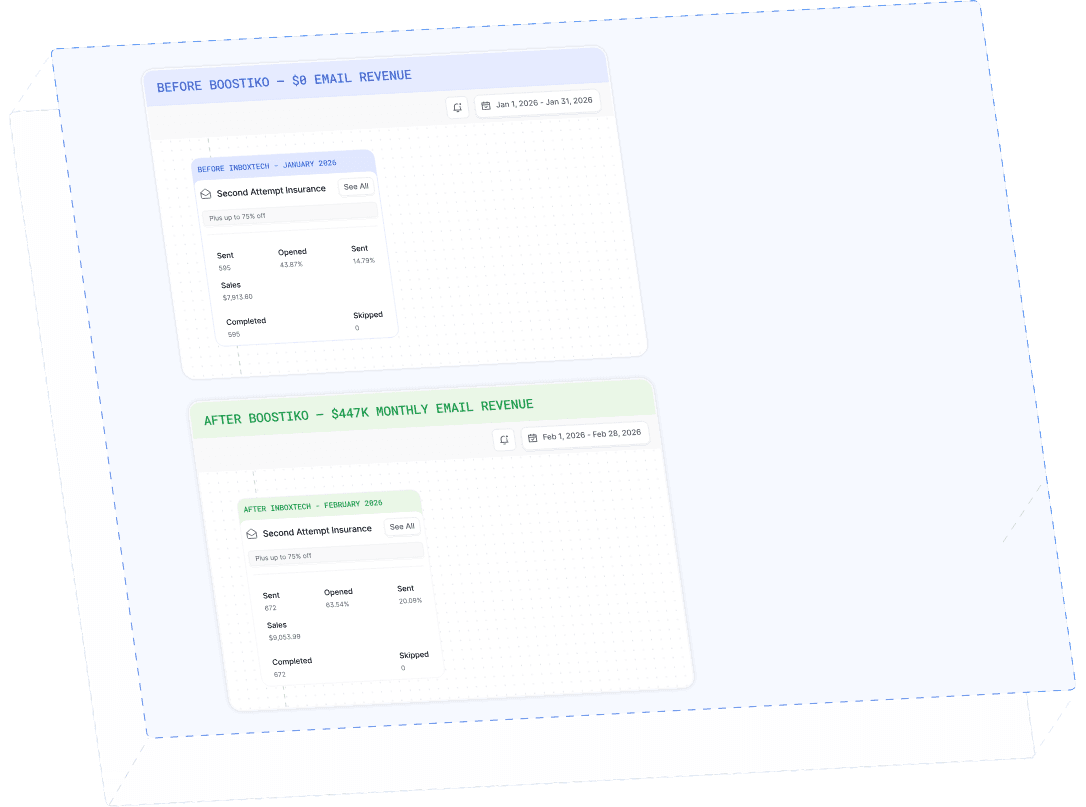
Case Study 01
Leading Prop Firm
$0 - $447K in 3 months
40.7% of total revenue
14 days time to first revenue
$0 to $447,115/month in Added Revenue in 90 Days