•
Boostiko Team

Crypto Prop Firm Email Marketing: Clear Account Status and Trade Confirmation Updates
A crypto prop firm customer should not have to guess whether an email is an account update, a trade confirmation, a security notice, or a promotion.
That sounds basic, but it becomes difficult when product teams, support, trading operations, and marketing all send from the same platform. A customer opens an email expecting a clear account status. Instead, they see a broad offer, an old rule summary, and a button that does not match the current dashboard. The message creates more questions than it answers.
A better system gives each email one job. Account status emails explain a verified change. Trade-confirmation emails point the customer to the authoritative record. Security emails explain the safe next step. Marketing campaigns are clearly promotional and follow their own consent, suppression, and unsubscribe rules.
This is general marketing and operations guidance, not legal, financial, trading, or compliance advice. Each firm should review its product, target markets, account terms, data handling, disclosures, consent records, and approval process with the appropriate advisers before sending.
Start with the source of truth
An email should not become the permanent record of a customer’s account. Status, trade details, rule conditions, available balances, eligibility, and access can change. The secure dashboard, account ledger, and current terms should own those facts.
That changes how a crypto prop firm writes its operational emails. Instead of making a long message carry every detail, the email can say what happened, when the system recorded it, and where the customer can review the latest account information. The main button should take the customer to the secure account area, not to a generic marketing landing page.
For example, a useful account-status email could say:
Your account status has been updated. Review the current details in your secure dashboard.
That sentence is clear because it does not make an outcome claim. It does not tell the customer that a trade is guaranteed to succeed, that a payout is certain, or that a specific account condition will last forever. It directs the customer to the live record.
Build a simple ownership map before creating automations:
The account platform owns current account status and access.
The trading or evaluation system owns the verified event record.
The customer dashboard owns the latest account details.
The terms page owns current program conditions.
Support owns individual questions and exceptions.
Marketing owns approved campaigns and audience rules.
When every team knows what it owns, the email program becomes much easier to audit and maintain.
Give account-status emails one purpose
Account-status messages can cover a range of real events. A customer may need to know that an account has been created, that a verification review is still pending, that a condition has changed, that access is ready to review, or that a support action has been completed.
The trigger must come from a verified event. Do not send a status email because someone entered a broad segment or because a spreadsheet was updated by hand. The message should be connected to the account system event that the firm can explain and support.
A practical status-email structure is short:
State the event in the subject line and opening sentence.
Explain only what the verified system record supports.
Link to the secure dashboard for the current details.
Provide an official support route.
Leave promotional content out of the main message.
“Your account status is ready to review” is safer than “Your account is about to unlock new opportunities.” The first sentence tells the customer where to look. The second implies an outcome that may not be confirmed.
The FTC says the primary purpose of an email matters under CAN-SPAM. Its guidance lists messages that facilitate, complete, or confirm an agreed transaction, update an account or standing in an ongoing relationship, or provide periodic account information as examples of transactional or relationship content. The FTC also says those categories are narrow. 1 An operational label alone does not decide the issue. The content, subject line, and context still matter.
Treat trade confirmations like receipts, not sales pages
A trade-confirmation email should answer a different question: what does the system show happened, and where can the customer verify it?
Do not turn that message into a performance story. Do not add a large offer for another product or present general market movement as personal trading guidance. The customer needs a reliable pointer to their official account record.
For an actual trade or evaluation event, the final language depends on the product and the data available. The email might confirm that an event record is available, that a requested action was processed, or that the customer can review their current activity. It should link to the secure dashboard where timestamps, applicable rules, and current records are maintained.
Avoid putting sensitive or overly detailed account information in an email body. Messages can be forwarded, previewed, or accessed on a shared device. A short notification with a clear secure-account link is often easier for the customer and safer for the operation.
A simple confirmation sequence can look like this:
Event recorded: Tell the customer that an account event is available to review.
Details available: Link to the secure dashboard, not a static campaign page.
Exception identified: Explain that the customer should review the account record or contact the official support route.
Support follow-up: Send a separate human support message only when a ticket or verified case needs it.
The important part is that the automation stops when the underlying state changes. If a support ticket is resolved, a confirmation email should not continue to send reminders based on an old status.
Keep operational and promotional tracks separate
Crypto prop firms may send both service updates and commercial campaigns. They should not use the same message for both jobs.
The operational track covers verified account, access, security, support, trade-event, and terms-related messages. It uses event-based triggers and sends customers to the dashboard, current terms, or support.
The promotional track covers offers, educational campaigns, product announcements, and reactivation. It uses an approved audience, clear commercial framing, consent and suppression controls where required, a current offer source, and the appropriate unsubscribe treatment.
The distinction matters because blended messages can be treated as commercial when promotion becomes the primary purpose. The FTC explains that, in mixed-content messages, the subject line and prominence of promotional material are part of the primary-purpose analysis. Commercial email requires accurate routing information, a non-deceptive subject line, a valid postal address, a clear opt-out method, and prompt opt-out handling. 1
This does not mean every account update needs the same treatment as a promotion. It means a firm should not hide a campaign inside an email that a customer reasonably expects to be a confirmation or service notice.
Use separate templates, audiences, and review steps. If a campaign needs to mention account education, write a commercial campaign. If a status email needs to help a customer understand their current account, write a status email.
Build sender trust before adding more automation
Clear copy will not help if the message does not reach the inbox. Account updates can be especially sensitive because they may look similar to phishing messages if the sender identity is inconsistent.
Google says all senders to personal Gmail accounts need SPF or DKIM authentication, valid forward and reverse DNS, TLS, and a low spam rate. For senders who send more than 5,000 messages per day to Gmail accounts, Google requires SPF, DKIM, DMARC, From-domain alignment, and one-click unsubscribe plus a visible unsubscribe link for marketing and subscribed messages. 2
Yahoo also recommends separating bulk or marketing traffic from user mail, transactional mail, and alerts because sending-IP and DKIM-domain reputation can affect delivery. 3
A crypto prop firm does not need a complicated stack to act on these principles. Start with these controls:
Use a stable, recognizable sending domain.
Authenticate every sending domain and check alignment.
Keep account and security messages away from broad promotional sends where your sending setup allows it.
Use a clear From name and a real reply or support path.
Suppress marketing messages after a valid opt-out.
Stop operational reminders when the verified account event is no longer active.
Test the secure dashboard link, support route, and mobile layout before each template goes live.
The goal is not to make every email look technical. The goal is to make the sender easy to recognize and the message easy to verify.
Write carefully around crypto and trading risk
Do not use account-status or trade-confirmation messages to make promises about trading results. Avoid phrases such as “guaranteed return,” “safe profit,” or “your next winning trade.” They do not belong in a customer account update.
The CFTC notes that virtual-currency markets can involve volatility, cyber risks, fraud, and other risks, and warns that there is no guaranteed investment or trading strategy. 4 That advisory is directed at virtual-currency investing and does not define a specific crypto prop-firm program. It is still a useful reminder to keep risk-adjacent communication factual and avoid outcome claims.
For firms marketing qualifying cryptoassets to UK consumers, the FCA says financial promotions must be fair, clear, and not misleading. Its policy statement discusses risk warnings, incentive restrictions, positive frictions, client categorisation, and appropriateness assessments. 5 A crypto prop firm should not assume that one set of rules applies in every market. Local counsel and compliance reviewers should determine the actual requirements for the product and audience.
In practice, this means an email team should ask a short set of questions before approval:
Is this an account update, a support notice, or a promotion?
Does the subject line match the message’s actual purpose?
Is every account statement connected to a live verified source?
Does the main button lead to the secure dashboard, current terms, or official support route?
Are any promotional claims, incentives, or risk disclosures reviewed for the markets involved?
Does the campaign follow the firm’s consent, suppression, and unsubscribe process?
That review is not bureaucratic overhead. It is how a firm prevents a useful account update from becoming a confusing or misleading campaign.
A practical build order
Do not try to launch every lifecycle branch at once. Start with the messages customers need most.
First, map the events that already exist in the account system. Next, identify the events that are trustworthy enough to trigger an email. Then create a plain-language template for each one. Connect each template to the secure dashboard or support route. Finally, add delivery controls and test the path from event to inbox to customer action.
A sensible first release may contain only four messages:
Account status ready to review.
Account or trade-event record available in the dashboard.
Security or access action requiring customer review.
Support case update with the official next step.
Once those messages are accurate and stable, marketing can build separate educational or promotional campaigns around them. The account track should remain dependable even when the commercial calendar changes.
Where Boostiko fits
Crypto prop firm email marketing is not only campaign copy. It is the operating system behind clear account communication, responsible promotions, sender trust, and customer support.
Boostiko helps teams map verified lifecycle events, separate operational and promotional tracks, write and design the email system, build the automation logic, and improve deliverability operations. That brings strategy, copy, design, technical setup, and ongoing lifecycle work into one team instead of leaving separate specialists to coordinate the details.
The result is a clearer account-email system that helps customers find the information they need while giving the firm a stronger foundation for responsible growth.
References
Continue reading



Case Study 01
Leading Prop Firm
$0 - $447K in 3 months
40.7% of total revenue
14 days time to first revenue
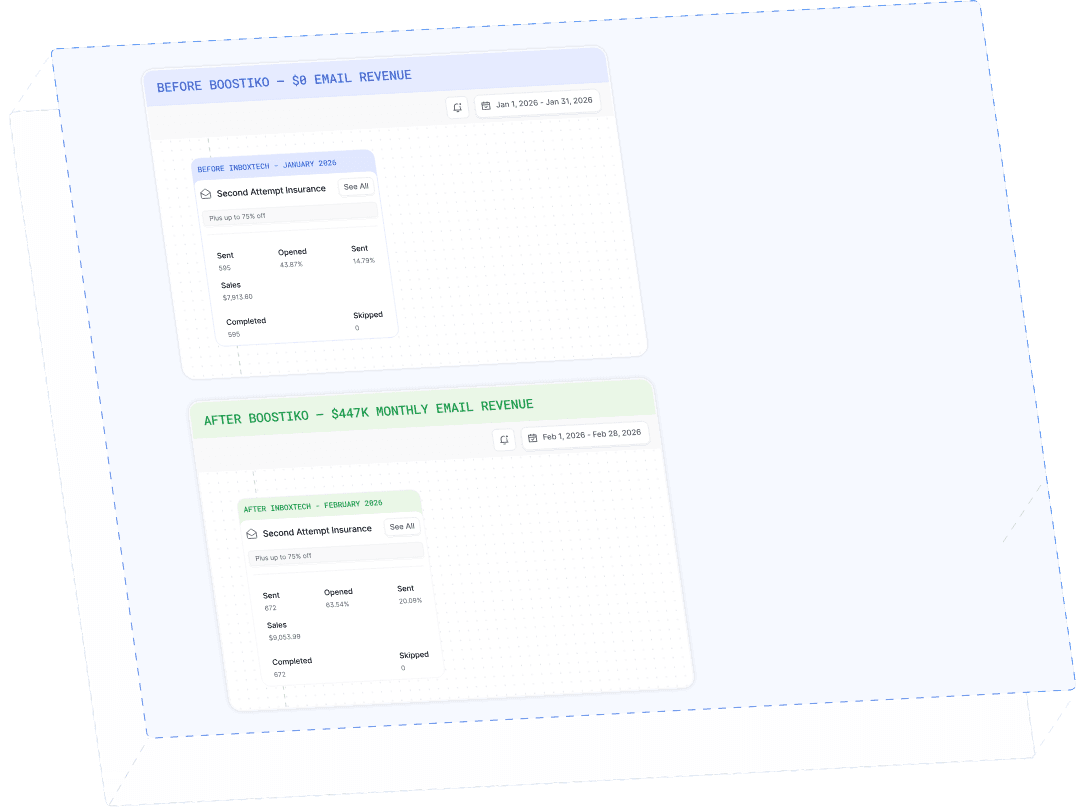
$0 to $447,115/month in Added Revenue in 90 Days