•
Boostiko Team
Email Marketing for Prop Firms: The Trader Lifecycle Retention System
Email marketing for prop firms is not a monthly newsletter. It is the retention system that connects a lead’s first interaction with the next relevant step: learning the rules, finishing registration, completing a challenge purchase, returning after a failed evaluation, or staying engaged after funding.
That distinction matters because a paid lead is not automatically a challenge buyer, and a challenge buyer is not automatically an active trader. Each stage has different questions, different data, and different messaging requirements. A single promotional blast cannot do the work of a structured lifecycle program.
Boostiko builds email and SMS retention systems for prop firms and brokers. The goal is to give each legitimate, permissioned contact a useful next step while keeping the sending infrastructure, data flows, and reporting under control.
The prop firm lifecycle is an email problem before it becomes a revenue problem
Most firms already invest in acquisition through paid media, affiliates, creators, communities, and organic content. The operational gap begins after a prospect shares an email address or starts a checkout. Without a defined follow up system, the prospect may never receive the information needed to make a decision, return to an interrupted purchase, understand a program change, or engage again at the right time.
A prop firm lifecycle has more states than a standard ecommerce funnel. Depending on the firm’s program and the recipient’s permissions, the relevant events may include a lead form submission, account registration, abandoned challenge checkout, challenge purchase, platform activation, an evaluation milestone, a failed evaluation, an account update, inactivity, or a request to change preferences. The marketing system should recognize these events and route contacts based on current status rather than repeatedly sending every message to every person.
The aim is not to send more email. The aim is to make each message appropriate to the recipient’s lifecycle stage, permissions, and stated preferences.
Build the data and permission layer first
A useful automation cannot be more accurate than the data that triggers it. Before writing subject lines or designing templates, document where the following information lives and how it is passed into the email platform:
Lead source and consent record, including the date, channel, purpose, and relevant jurisdiction.
Registration, checkout, payment, and challenge purchase events.
Challenge, evaluation, account, or support events that are appropriate to use for communication.
Current preference, unsubscribe, complaint, suppression, and eligibility status.
The source of truth fields in the customer relationship management system, checkout, trader management system, and email service provider.
This foundation prevents a common failure mode: a contact receives a recovery sequence after converting, receives a promotion after opting out, or receives messaging that conflicts with an account notice. A clean data map also makes it possible to measure what a flow actually did instead of attributing every later purchase to the most recent email.
Where an email program touches multiple tools, the integration should be tested with controlled events before it is switched on. For example, the team should confirm that a completed purchase exits an abandoned checkout flow and that an unsubscribe is respected across the systems that send promotional messages.
The core prop firm email flows
1. Welcome and program education flow
A welcome sequence should help a new, permissioned prospect understand what the firm offers and how to take the next appropriate action. It can explain the available program, the evaluation process, the platform, the support route, and where to find current rules and terms.
The message should not imply a guaranteed pass, payout, profit, or funded account. Clear, factual education is usually more valuable than pressure, especially when the prospect is still comparing firms or trying to understand a program’s requirements.
2. Registration completion and abandoned checkout recovery
A prospect who starts registration or checkout has shown different intent from a cold subscriber. A recovery flow can help the person resume an interrupted action, find support, or review the information needed to complete the process. The trigger must be accurate, and the person must exit the flow when the event is completed.
Useful recovery messaging answers practical questions: Was there a technical issue? Is an account step incomplete? Where are the current terms? Is support available? It should not create artificial urgency, hide material conditions, or imply that a trading outcome is assured.
3. First day onboarding and rule education
After a challenge purchase or account activation, the immediate priority shifts from conversion to clear onboarding. This is a good time for operational guidance: platform access, support links, current program documentation, account setup, and a sequence of educational resources.
Transactional or account service messages should be identified and handled separately from promotions. When a message contains both service information and a material promotion, its treatment can depend on the message’s primary purpose and the laws that apply to the recipient. Have the firm’s compliance team review the final classification and copy.
4. Evaluation stage communications
Evaluation-stage messaging should be governed by the firm’s actual program rules and data permissions. It can point traders toward approved educational resources, support, current account information, and reminders to review the authoritative rules. It should not encourage behavior that conflicts with the firm’s policies or oversimplify risk.
Whenever a flow refers to rule thresholds, payment conditions, platform behavior, or eligibility, link to the current source of truth and give the content an owner and review date. Prop firm rules and platform arrangements can change, so a stale lifecycle email can create a trust and support problem quickly.
5. Failed evaluation and reactivation journeys
A failed evaluation should not automatically trigger an aggressive sales broadcast. A thoughtful reactivation path can first offer relevant education, support resources, and a clear route to current program information. If a promotion is appropriate and permitted, it should be audience specific, accurately described, and easy to decline.
Segments matter here. A new prospect, a repeat customer, an inactive contact, and a person who has opted out of promotions should not receive the same message. Treat the journey as a retention and communication problem, not simply a discount delivery problem.
6. Funded trader, payout, and account status communication
These messages demand the highest operational discipline. Account updates, payout status communications, and material rule changes should be accurate, traceable, and clearly separated from promotional programs where necessary. Use the firm’s verified system data, apply quality assurance before sending, and make sure the support team can resolve questions created by the message.
For promotional content aimed at active or funded traders, use an explicit permission and eligibility check. Do not imply that past outcomes predict future results or that additional purchases guarantee a particular account, payout, or performance outcome.
7. Inactivity, preference management, and win back
Not every quiet contact needs a discount. An inactivity flow should help a firm distinguish among people who are no longer interested, people who need updated information, and people who may want a different message frequency or content category.
A preference centre, visible unsubscribe route, and suppression process are essential. In the United States, CAN-SPAM requires, among other things, accurate headers, truthful subject lines, a valid physical address, a clear unsubscribe route, and prompt handling of unsubscribe requests. It also makes clear that hiring another company to send messages does not remove responsibility from the promoted business. 1 In the United Kingdom, marketing email requirements can differ by recipient type and consent status. The ICO explains the limits of the current customer soft permission and the requirements around identity and opting out. 2
Deliverability is an operating discipline
A strong sequence cannot help if it is not delivered reliably. Deliverability work begins with permissioned acquisition and good data hygiene, then continues through authentication, audience management, sending practices, and monitoring.
For Gmail, Google’s sender guidelines require all senders to use SPF or DKIM. High volume senders have additional authentication, alignment, unsubscribe, and spam rate requirements. 3 These controls support responsible delivery. They are not a promise that a message will reach a specific inbox tab or that every recipient will see it.
A practical prop firm deliverability program usually includes the following controls:
A documented consent and suppression model, with complaint and unsubscribe signals flowing back to the source systems.
Validation and removal processes for invalid, unengaged, or inappropriate contacts.
Authenticated sending domains, sensible separation of promotional and account service traffic where appropriate, and monitored sender reputation.
Tested templates that render clearly on mobile devices and link only to current, verified destinations.
Review steps for financial claims, testimonials, rule references, and promotions before launch.
Measure the system, not just the campaign
Open and click metrics can reveal operational issues, but they do not prove that an email caused a purchase, funding event, payout, or increase in trader lifetime value. A mature program defines the event to be measured, its baseline period, its attribution method, and its limitations before reporting a result.
At minimum, a prop firm should be able to review the following by flow and audience segment:
Layer | Questions to answer |
|---|---|
Permission and delivery | Was the recipient eligible and permissioned? Did complaints, bounces, or unsubscribes increase? |
Journey operations | Did the correct event start and stop the flow? Did converted contacts exit recovery messaging? |
Engagement | Which educational or support resources were useful enough to earn a response or return visit? |
Business event | What defined action occurred, during which period, and under what attribution or comparison method? |
Quality and compliance | Were claims, terms, disclosures, and current rules reviewed before the message sent? |
When a firm wants to claim a business result, it should retain the supporting evidence: a clear timeframe, event definition, source data, attribution method, material constraints, and client approval where a case study is involved. Boostiko’s existing case study material should be presented as a documented example, not as a universal promise for every prop firm.
Agency versus an internal team: what the operating model changes
Building a serious prop firm retention program inside the company is not normally one job. It spans at least five functions: an email designer to create and test the assets, a copywriter who understands the audience and offer, an operations lead to manage calendars and quality assurance, a technical specialist to connect event data and platforms, and a deliverability expert to maintain sending infrastructure and diagnose issues.
Boostiko combines those capabilities into one managed engagement. Instead of coordinating separate hires, contractors, tools, and handoffs, the firm works with one team responsible for the flow strategy, creative, implementation, campaign operations, and deliverability controls. The practical benefit is faster coordination and a single accountable operating system, not a collection of disconnected email tasks.
For many firms, the relevant comparison is not an agency fee versus one employee’s salary. It is the cost and management load of assembling up to five specialist functions: design, copy, operations, technical integration, and deliverability. Actual savings depend on the required scope, market, seniority, current tooling, and internal capacity, so Boostiko should show the comparison transparently in a scoped proposal rather than present a universal cost claim.
What to look for in a prop firm email marketing partner
The right partner should understand more than email design. Ask how they will map customer data, manage consent and suppression, connect checkout and trader events, handle account service versus promotional messaging, authenticate and monitor sending infrastructure, and report results with limitations.
The questions are straightforward:
Which lifecycle events will trigger each flow, and which systems provide the data?
How will the program honor unsubscribes, complaints, preferences, and eligibility checks?
How will completed purchases and account changes stop or redirect irrelevant automation?
What is the review process for current rules, financial claims, testimonials, and promotions?
Which delivery, journey, and business metrics will be reported, and how will attribution be defined?
A partner that can answer these questions can help build a controlled retention system rather than a collection of disconnected campaigns.
Map your prop firm retention system
Boostiko helps prop firms and brokers design and operate email and SMS lifecycle programs across list hygiene, deliverability, CRM and platform integrations, campaigns, popups, and automated trader flows. The first step is to map the current journey, the available data, the sending infrastructure, and the top priority gaps.
If your firm wants a practical view of its lifecycle, from lead capture through onboarding, inactivity, and win back, request a Trader Lifecycle & Deliverability Audit. We will review the flow architecture and implementation prerequisites before recommending a scope of work.
This article provides operational marketing guidance, not legal, financial, or trading advice. The applicable rules depend on the recipient, jurisdiction, firm, offer, message purpose, and current platform policies. Have qualified legal and compliance reviewers approve campaign copy, consent practices, disclosures, and account communications before launch.
References


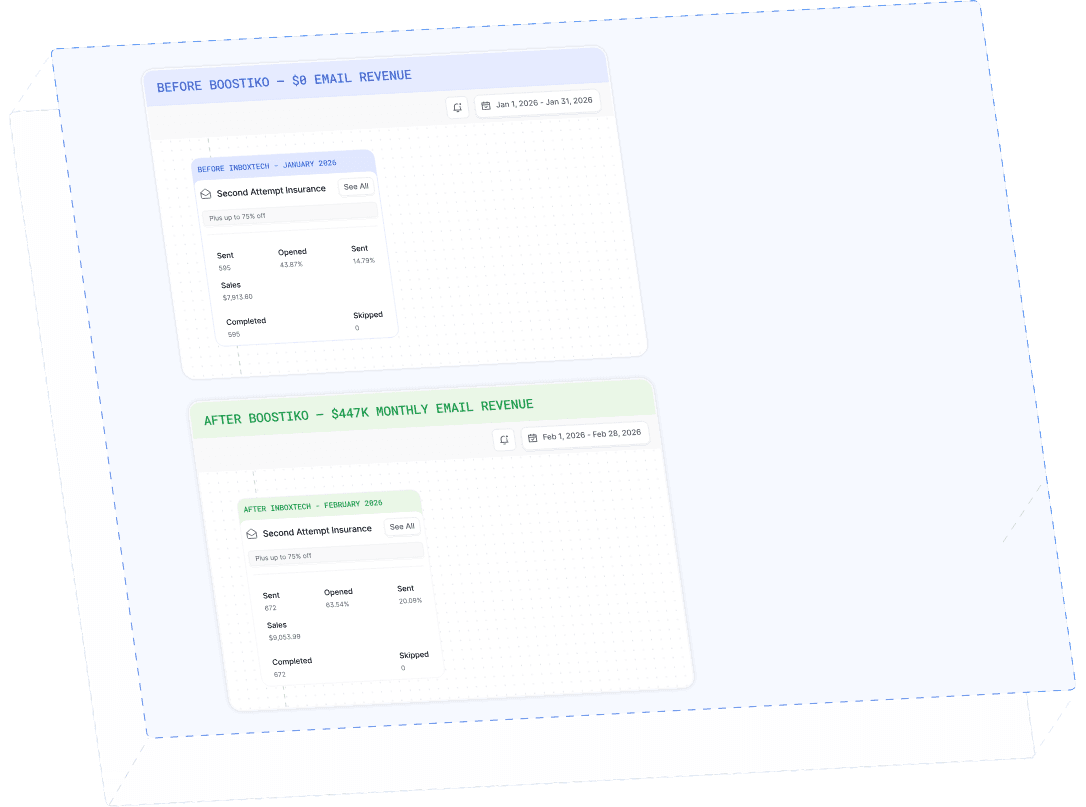
Case Study 01
Leading Prop Firm
$0 - $447K in 3 months
40.7% of total revenue
14 days time to first revenue
$0 to $447,115/month in Email Revenue in 90 Days