•
Boostiko Team
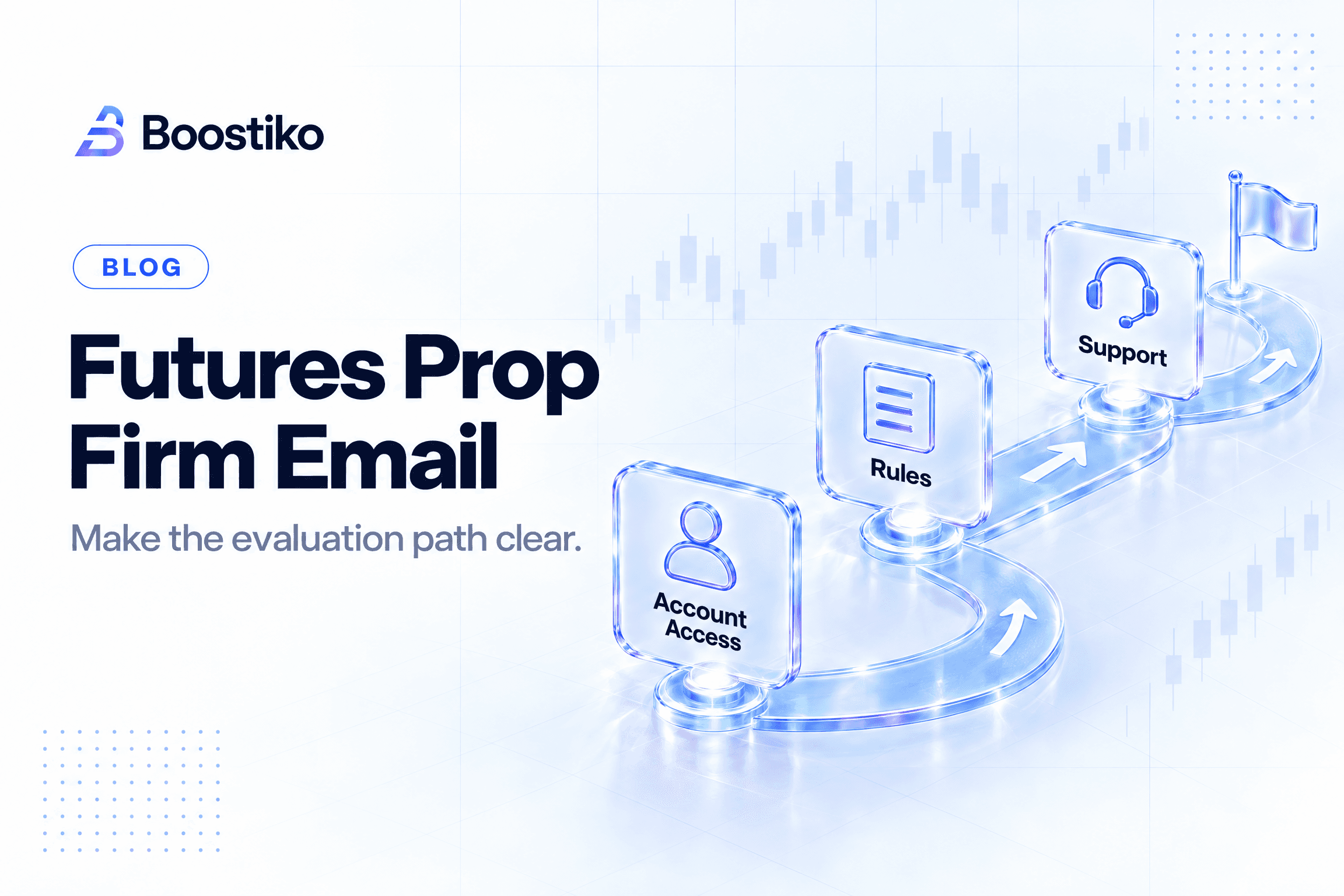
Futures Prop Firm Email Onboarding: Make the Evaluation Path Clear
Futures prop firm email onboarding should answer the questions a trader has after buying an evaluation: what happens now, where are the rules, what must be completed, and where can they get help.
A broad welcome campaign does not do that job. It may thank the customer and promote the community, but leave them unclear about the evaluation path. That creates avoidable support tickets, confused rule questions, and poor trust at the exact moment the relationship starts.
This article is about the email operation behind a clear evaluation experience. It is not investment advice, legal advice, or a promise of funding, trading results, or account performance. A futures prop firm must use its own approved rules, disclosures, jurisdictions, and review process.
The onboarding problem begins after the checkout receipt
A new evaluation customer has just made a decision. They need an accurate route into the product, not a stream of generic motivation.
The first questions are practical. How does access work? Which rules apply to this evaluation? What does the dashboard show? Which actions are required before trading? What happens if a rule changes? Where is the official support route?
When these questions are not answered in order, the customer has to search through a help centre, group chat, platform guide, and promotional emails. That is not a content problem. It is a lifecycle design problem.
The basic theory is simple: send the information that makes the next legitimate step clear before the customer has to hunt for it. A well designed onboarding sequence reduces uncertainty without making trading claims or pushing a trader into action.
For U.S. regulated futures intermediaries, the CFTC describes formal account opening and disclosure obligations for futures commission merchants and introducing brokers. A prop firm may operate under a different model, but the principle is still useful: important risk and account information should be clear, deliberate, and easy to find. 1
Build the journey around real evaluation states
Do not divide the audience only by open or unopened emails. Use states that match what the customer is trying to do.
A useful starting map can include a new evaluation purchase, account access not completed, platform setup in progress, first session completed, rule question raised, evaluation status updated, marketing opt out, and support escalation. The exact labels depend on the firm, but each state should have one owner and one clear purpose.
New purchase needs confirmation. Send a factual receipt, the official evaluation name, the start point, the access route, and a link to the current rules. Do not hide a required condition inside a long promotional block.
Access not completed needs practical help. A follow up can explain the setup steps, identify the official support channel, and link to the relevant platform instructions. It should not imply that a person is losing an opportunity because they have not started.
Setup complete needs orientation. The message can explain where a trader can view account status, find the current rule set, and request support. Keep it factual. The purpose is understanding, not a claim about possible outcomes.
Rule or policy update needs a clean operational notice. State what changed, when it takes effect, which account types are affected, and where the full approved policy lives. A promotional offer should not compete with that notice.
Marketing opt out needs a reliable suppression. The person can still receive necessary account or security messages where permitted, but marketing preferences must not depend on a manual campaign exclusion. The system should record the decision at the source and apply it to every relevant sending path.
A five message evaluation onboarding sequence
A compact sequence is easier to run and easier to improve. The following structure gives the customer useful information without turning the inbox into a pressure channel.
1. Start here
Send this immediately after the purchase event. Confirm the evaluation, explain how access is delivered, link to the current rule page, and show the support route. Use a precise subject line such as “Your evaluation access and next steps.”
This message needs a single job: help the customer begin. It is not the place for trading tips, exaggerated social proof, or a time limited upsell.
2. Know the evaluation path
Send this when the account is ready or when the buyer has completed the required access steps. Explain the stages using the firm’s approved terminology. For example, the message can point to the dashboard, rules page, platform instructions, and help centre.
Avoid rewriting account rules from memory in an email template. Link to a controlled source of truth and use a versioned content block for the short explanation. When rules change, the team knows what must be reviewed.
3. Set up with confidence
Send a focused setup message after the customer has had time to log in. Cover platform access, where to find account information, and how to contact support. If the firm has a knowledge base, choose three or four links that solve the most common early questions.
Keep the language direct. “Find your current rules here” is better than “Unlock your trading potential.” The customer needs a reliable answer, not a slogan.
4. Acknowledge the first milestone
Use a real product event, not a guessed engagement score. A first completed login or a verified account setup can trigger a note that confirms where to find their status and help. Do not use this message to suggest that a trader is likely to pass an evaluation or earn a payout.
Where a firm uses performance or financial statements in a regulated member context, NFA Rule 2 29 is a useful reminder. It prohibits high pressure approaches and misleading promotional material, and requires profit references to be paired with equally prominent discussion of risk of loss. The rule applies to the specified NFA member categories, so the firm should confirm its own scope with qualified reviewers. 2
5. Keep preferences and help visible
The final onboarding message can explain how to manage marketing preferences and where to receive product support. It should separate marketing controls from account access. A customer should never have to remain subscribed to promotions to find a support answer.
This is also a good point to ask one simple question: “Was the setup information clear?” Use the answer to improve the help content and email sequence. Do not use it as a reason to add a person to another marketing list.
Separate operational mail from promotion
An operational email helps the customer use a product they already bought. A marketing email promotes a new purchase, upgrade, or offer. A single message can contain both, but mixing them makes the purpose harder to understand and can create review problems.
The FTC explains that the primary purpose of an email determines whether it is commercial under CAN SPAM. When a message is commercial, the sender needs accurate routing information, a non deceptive subject line, a valid postal address, and a clear opt out route. A business remains responsible even if a partner sends the message. 3
Use that distinction in your campaign calendar. A change to evaluation rules, account access, a security alert, or a support response should be designed as an operational path. A discount, new evaluation offer, or renewal promotion should sit in a marketing path with its own consent, audience, terms, and approval checks.
This makes the work easier for the customer and easier for the team. Support knows which messages answer account questions. Marketing knows which audiences are eligible for offers. Compliance reviewers see the reason for each send.
Make the rule page the source of truth
Every email about an evaluation should point back to a maintained, approved rules page. Treat that page as the canonical source. Do not make the inbox carry the full policy.
The email can state the practical reason for the link: “Review the current evaluation rules before you trade.” It can state an effective date when the firm has one. It can identify the support route if a customer has a question. It should not imply that an old email is the definitive rule set after the policy has changed.
Set an owner for rule related content. That person does not need to write every email. They need to confirm which rule version applies, alert the lifecycle team to changes, and approve the controlled message block. This reduces the risk of an old automation sending a stale explanation.
A simple content register helps. Record the rule page URL, rule version, applicable account type, effective date, email template, approval owner, and last review date. If a team cannot answer those fields, it is not ready to automate the message.
Deliverability is part of onboarding quality
A clear email that lands in spam is not clear to the customer. Deliverability starts with consent, sending identity, authentication, and useful content.
Google requires SPF or DKIM for all senders to personal Gmail accounts. Higher volume senders must use SPF, DKIM, and DMARC, align the From domain with SPF or DKIM, keep reported spam rates below 0.3 percent, and provide one click unsubscribe for marketing and subscribed messages. 4
The operational response is not to send more reminders. It is to make each category useful. Send account messages from a stable identity. Keep promotional content in a consented marketing stream. Monitor bounces, complaints, unsubscribes, and delivery by message class. Remove invalid addresses and investigate a complaint trend before the next campaign.
If a firm sends to UK individuals, the ICO says marketing email normally needs specific consent, subject to a limited soft opt in for the sender’s own similar products and existing customers. It also requires a simple opt out path and a valid sender identity. 5
The exact rule depends on the market and recipient. The system should therefore store consent source, time, wording, channel, jurisdiction where relevant, and the customer’s current preference. Do not treat a generic checkout agreement as a complete marketing record.
Agency versus in house: who owns which part?
An in house team owns information that no agency can invent. It knows the approved rules, product changes, customer support themes, platform details, and internal escalation routes. In a futures prop firm, that knowledge is critical.
The issue is coverage. A full onboarding program needs copy, design, email operations, technical setup, deliverability, analytics, and a reliable approval process. If one CRM manager has to handle every part, the team often sends whatever is urgent and leaves the lifecycle gaps open.
Boostiko can bring those specialist functions together in one working team. We map the lifecycle, build the templates, create the flows, maintain the sending operation, and improve deliverability discipline. The futures prop firm keeps ownership of rules, product truth, legal interpretation, disclosures, and final approval.
That is shared accountability. The brand supplies accurate, approved inputs. Boostiko turns those inputs into a clear customer journey and an operating system that the team can run.
The Boostiko solution
Boostiko helps futures prop firms replace scattered confirmation emails with a practical onboarding system. We audit the journey after checkout, identify unclear steps, map communication states, separate operational and promotional email, build controlled templates, and put the relevant performance and deliverability checks in place.
We do not promise evaluation passes, funded accounts, payouts, or trading results. We help teams make the customer experience clearer and the email operation more reliable.
If your evaluation onboarding sends customers searching for answers, talk to Boostiko about a futures prop firm email lifecycle audit.
FAQs
What should a futures prop firm send after an evaluation purchase?
Start with a factual confirmation, access instructions, the current rules source, and a support route. Follow with setup and orientation messages based on actual customer events. Keep each message focused on one next step.
Should rule changes be sent as marketing emails?
No. A rule or policy change is an operational communication. Keep it separate from discounts, upsells, or promotional language. State the effective date, the affected accounts, the current source of truth, and the support route.
Can an onboarding email include a performance claim?
Only use a claim when it is approved, substantiated, and reviewed for the firm’s actual regulatory and jurisdictional context. Do not make claims about likely evaluation passes, profits, or payouts. Where NFA Rule 2 29 applies, it has specific rules for promotional material and performance content. 2
What is the most useful onboarding metric?
Measure the quality of the process: access completion, help centre use, support themes, rule page visits, delivery, bounce rate, complaints, unsubscribes, and the accuracy of triggered messages. Do not treat a single engagement metric as proof that onboarding is working.
Does Boostiko approve rules or legal disclosures?
No. Boostiko provides lifecycle strategy and execution. The client keeps responsibility for product rules, legal and regulatory review, disclosures, data use, and final sends.
References
Continue reading



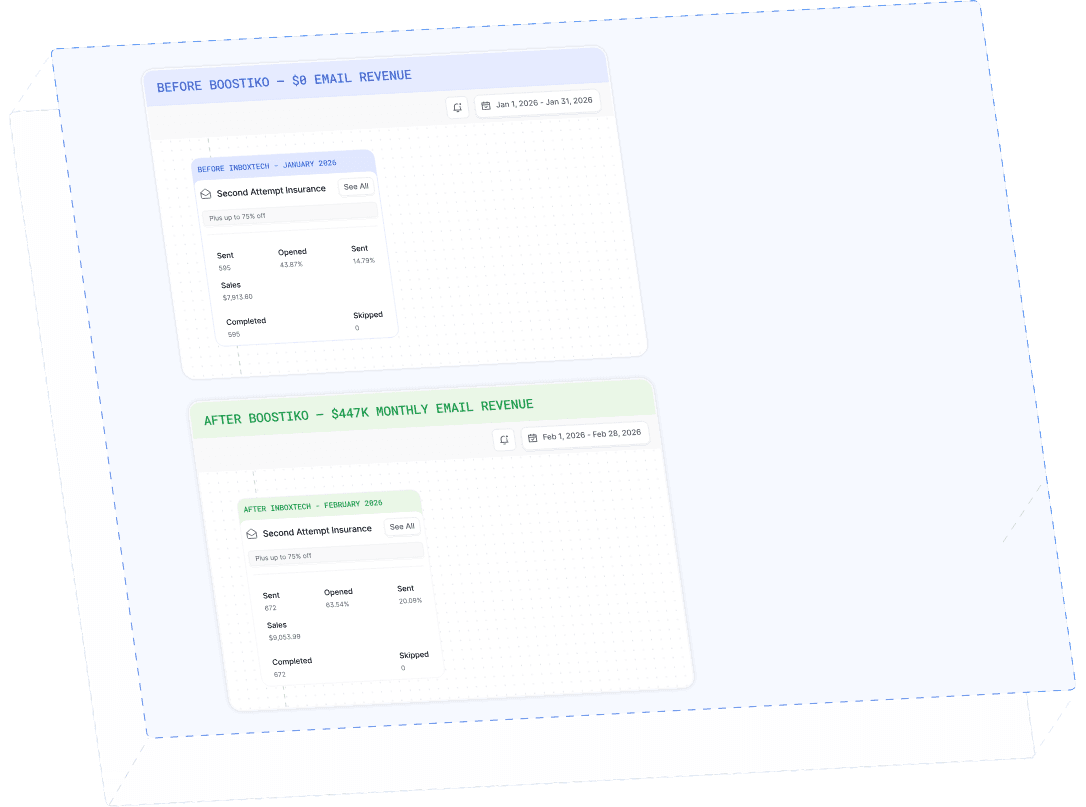
Case Study 01
Leading Prop Firm
$0 - $447K in 3 months
40.7% of total revenue
14 days time to first revenue
$0 to $447,115/month in Email Revenue in 90 Days