•
Boostiko Team

Prop Firm Renewal Emails: Make Account Deadlines Clear
A prop firm renewal email has one simple job: tell the trader what is changing, when it changes, and what they can do next.
That sounds basic. It is often where confusion starts.
A trader may have an evaluation that is about to expire. They may be eligible for an extension. Their billing date may be approaching. A reset may be available. Their account may be paused, cancelled, or moving to a different status. Those are different situations. They should not be squeezed into the same generic promotional campaign.
Clear renewal email is not only better for the customer. It also gives the marketing team a safer system to operate. Account notices stay useful. Promotions stay separate. Support gets fewer avoidable tickets. The sender reputation is less likely to be damaged by recipients who feel surprised or pressured.
This guide shows how to build a prop firm renewal email flow that puts the account status first and the marketing second.
This is general marketing and operations guidance. A firm should have its legal and compliance team review the actual terms, disclosures, permissions, and copy for every market it serves.
Start with the real account state
A renewal email should come from a reliable account event, not from a loose spreadsheet or a marketer's manual export.
Before the message is sent, the system needs a source of truth for:
the account or evaluation identifier
the current plan or product
the exact deadline and timezone
the status after the deadline
the price and rules that apply if a renewal, extension, reset, or restart is offered
the official support path
The message should state only what the account record can support. If the deadline is still being calculated or a promotion has not been approved, do not send a vague email saying that a trader must act immediately.
The best operational rule is simple: the CTA must match the account state.
A trader whose evaluation ends in seven days may need a button that says “View account options.” A trader whose account has already expired may need “Review restart options.” A trader with no available extension should be sent to support or the dashboard, not to a checkout page that promises an option they cannot use.
Make the deadline impossible to miss
The account information should appear before any offer language.
A practical renewal notice has four elements near the top:
A specific subject line, such as “Your evaluation access ends on October 18.”
The program or account name, so the trader knows exactly what the email concerns.
The date, time, and timezone of the change.
One primary next step, such as reviewing the dashboard, an approved extension option, or support.
Avoid subject lines that create artificial uncertainty. “Final warning” and “Last chance before it is gone” can turn a routine account notice into a pressure message. If the deadline is real, say what it is. If an offer has a real end date, show the terms in the email and on the destination page.
This matters in financial-services-adjacent marketing. NFA Rule 2-29 prohibits certain communications that are fraudulent, deceptive, high-pressure, or misleading by omission. It also requires a balanced treatment of profit possibility and risk where those topics appear. The rule applies to specific NFA members and associates, but its clarity standard is useful for any trading-related brand: do not let a short email hide a condition that changes the meaning of the offer. 1
Separate account notices from promotional messages
A renewal flow usually contains two kinds of email:
Account messages that update an existing customer about their status, deadline, account terms, or available account action.
Marketing messages that promote a new plan, discount, bundle, or general opportunity.
Do not assume that an email is an account notice just because it is sent to a customer.
The FTC explains that a message about an account relationship can be transactional or relationship content when it updates the recipient about a change in the terms, features, or standing of an ongoing commercial relationship. But the classification depends on the message's primary purpose. When promotional content leads the subject line or dominates the layout, the message may be treated as commercial instead. 2
For a prop firm, that means an expiry reminder should not lead with a coupon. Put the account status and its next step first. If the team wants to offer a code or a new product, send that as a separate marketing email to people who are eligible to receive it.
A clean structure looks like this:
Account notice
Subject: “Your evaluation access ends on October 18”
Main content: account state, deadline, what changes, dashboard link, support link
Optional footer: a short reference to available options, without taking over the email
Marketing message
Subject: “Approved renewal options for your next evaluation”
Main content: the offer, full terms, audience eligibility, risk review, clear CTA, unsubscribe controls
Sent only to the correct consented or otherwise permitted segment
This separation makes the messages easier to write, easier to review, and easier for a trader to trust.
Use a calm renewal sequence
Not every customer needs the same number of reminders. The right cadence depends on the product, the account terms, and the trader's actions. A useful starting framework is event-led rather than volume-led.
1. Early account reminder
Send the first notice when the trader still has time to understand the account state. State the exact deadline and link to the dashboard. Do not turn this into a countdown campaign.
2. Clear action message
Send a follow-up only if the product actually has a valid action available. For example, an approved extension, renewal, reset, or support review. The email should state the cost, eligibility rules, deadline, and what happens after payment.
3. Final status notice
When the account changes, send a factual confirmation. It should explain the new state, retain access to any records the firm has promised to retain, and give the trader the correct support route.
4. Separate re-engagement message
If a former customer is eligible for marketing, send a later re-engagement campaign separately. It should be based on permissions and clear commercial content, not disguised as an urgent account update.
Do not use an auto-resend rule just because someone did not open the first email. A non-open does not prove the first message was not delivered or not understood. It may be better to resend only a genuine account notice with a clear, accurate subject line, and only when a second notice is justified by the actual account event.
Write terms into the email, not behind the button
The renewal email does not need to carry every legal term. It does need to show the terms that would change a reasonable trader's decision.
For example:
price and currency
whether the action is a renewal, extension, reset, or a new purchase
the account or evaluation product covered
the end date of an offer, if one exists
whether a code applies automatically or must be entered
material eligibility limits
where the trader can read the full program terms
The destination page must match the email. If the email says “keep your current account active,” but checkout creates a different product or new account, the email needs different copy.
This is also where teams should avoid trading performance language. If an email includes a claim about possible profits, past results, or hypothetical performance, it needs a compliance review appropriate to the business and jurisdiction. For NFA members and associates, Rule 2-29 includes specific requirements around profit references, past performance, and hypothetical results. 1
A renewal message can usually do its job without any performance promise. Lead with account facts and customer choice.
Keep the sender identity consistent
Renewal email is especially sensitive because it often asks a trader to sign in, review billing, or make a payment. The sender identity should make that request easy to verify.
Use a stable From name and sending domain. Link to the official dashboard. Do not ask customers to send passwords, recovery phrases, wallet seed phrases, or payment details by email. Do not use a shortened or unfamiliar domain for the CTA.
For Gmail delivery, all senders need SPF or DKIM authentication. Bulk senders need SPF, DKIM, and DMARC, plus aligned domains and one-click unsubscribe support for marketing and subscribed messages. Google also says authenticated messages help protect against spoofing and phishing. 3
This technical work is not separate from copy. A clear sender name, correct domain, verified links, and an accurate subject line all help a trader decide whether a renewal notice is legitimate.
Give marketing recipients real control
A customer relationship does not remove a person's right to stop marketing emails.
For commercial email under CAN-SPAM, the FTC says marketers need accurate sender information, non-deceptive subject lines, a valid postal address, a clear opt-out method, and prompt processing of opt-out requests. The guidance says an opt-out must be honored within 10 business days. 2
For UK electronic mail marketing, the ICO says marketing emails to individuals generally need specific consent, subject to a limited soft opt-in for an organisation's own similar products or services. It also requires a clear way to opt out and a valid contact address. 4
Build the flow around those distinctions:
Send true account notices from the transactional stream.
Send marketing renewal offers only to the appropriate permissioned audience.
Use a preference center so subscribers can reduce marketing without missing essential account messages.
Honor suppression lists across every tool that sends campaigns.
Keep consent, source, date, and preference changes in the customer record.
This protects the customer experience. It also prevents a team from rebuilding the same exclusion rules every time a promotion is launched.
Measure clarity before volume
A renewal flow should not be judged only by revenue or conversion rate.
Start with operational signals:
support tickets about deadlines or account status
failed or abandoned renewal attempts
payment errors and their causes
clicks to the official dashboard
opt-outs and spam complaints from promotional messages
mismatch reports between email copy and checkout terms
Then review the commercial numbers with context. A higher conversion rate can be a warning sign if complaints or refund requests rise at the same time. A lower conversion rate may be acceptable if the campaign is reaching only people with the correct permissions and product eligibility.
The strongest renewal email program is not the loudest one. It is the one a trader can read quickly, verify easily, and act on without guessing.
A simple implementation plan
A prop firm does not need a huge automation map to start improving renewal email.
First, map the actual account states with operations and support. Agree on the event names, deadlines, timezones, and allowed actions. Second, write one plain account notice for each state. Third, separate approved marketing offers from those notices. Fourth, connect the email platform to the same account data that the support and checkout teams use. Finally, review the first campaign with compliance, support, and deliverability data in one place.
This is the work Boostiko handles for regulated and high-consideration brands: lifecycle structure, email design, copy, technical delivery, audience controls, and operational QA. Book a strategy call to review the renewal path your traders currently receive.
References
Continue reading



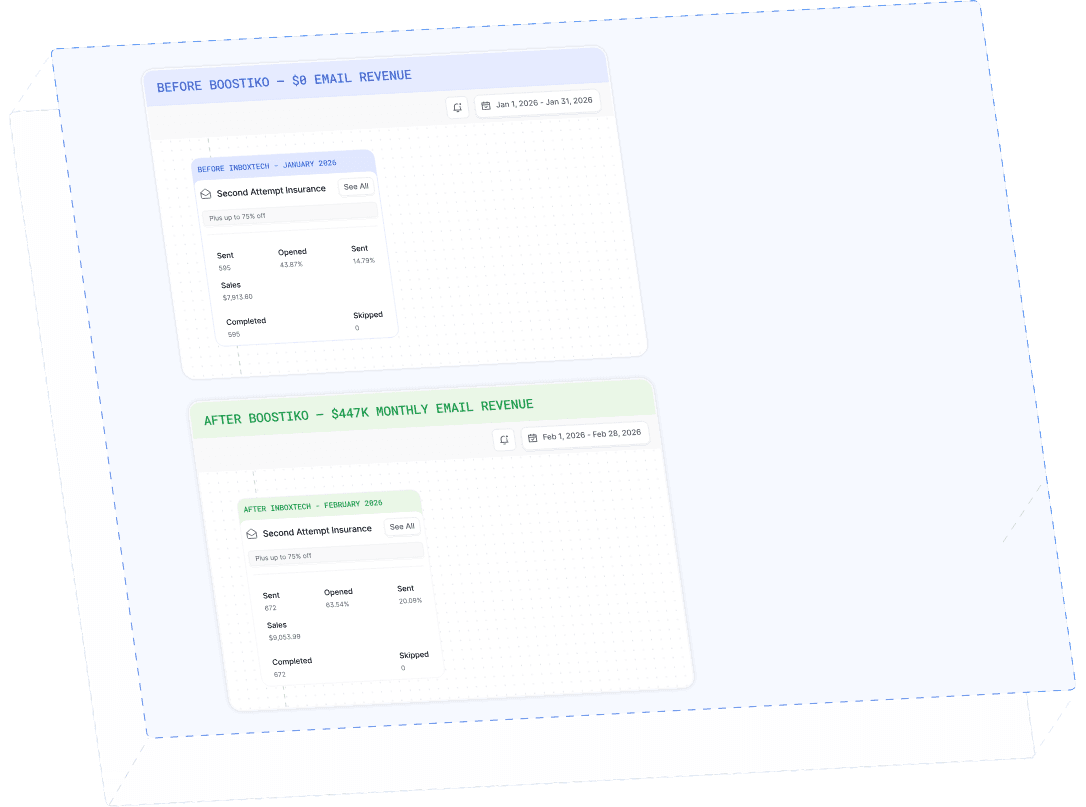
Case Study 01
Leading Prop Firm
$0 - $447K in 3 months
40.7% of total revenue
14 days time to first revenue
$0 to $447,115/month in Added Revenue in 90 Days