•
Boostiko Team

Email Marketing for Peptide Brands: A Compliance-Conscious Retention System
Email Marketing for Peptide Brands is not about finding sharper health claims or sending more promotions. It is about building a controlled system that knows what the brand may say, who it may contact, which customer state matters now, and when a message must stop.
“Peptide brand” is not one regulatory category. A research-use-only catalogue, a dietary-supplement adjacent business, and a telehealth or compounded-drug adjacent operator can look similar in a CRM while facing different rules. The product model, jurisdictions, approved claims, privacy posture, recipient permission, and email-service-provider policy should shape the lifecycle before a team writes a subject line.
This is an operational guide, not legal or medical advice. The regulated entity and its qualified legal, regulatory, medical, and privacy reviewers decide product status, eligibility, substantiation, and final approval. An email partner can turn those decisions into a working retention system. It should not replace them.
The business problem: interest arrives faster than control
Peptide brands may have landing pages, creator content, a welcome series, and abandoned-cart reminders. The problem is that those parts often operate independently. A subscriber who asked for general information receives the same sequence as a repeat customer. A withdrawn preference fails to reach the ESP. A support email contains a promotion. Old copy reappears without anyone checking whether the current product or market supports it.
That fragmentation creates commercial waste and claims risk at the same time. The team loses relevance because it cannot identify the customer’s actual state. It loses control because no one can show why a statement appeared, which audience received it, or whether the customer should have been excluded.
For health-related products, cautious wording alone is not enough. The FTC says objective claims, including implied claims, need adequate substantiation before an ad is disseminated. Health-benefit and safety claims generally require competent and reliable scientific evidence. A brand also cannot use a customer story to communicate a claim it could not substantiate directly. 1
Peptide marketers should not treat a label as a workaround. In a 2025 warning letter, FDA explained that “research use only,” “not for human consumption,” and similar statements did not resolve the issue where surrounding web claims evidenced intended human drug use. 2 The practical email lesson is to assess the whole communication, not the disclaimer at the bottom.
Lifecycle theory: state, permission, claim, and intent
A durable lifecycle starts with four facts. State is where the person is in a documented journey. Permission is whether marketing may be sent. Claim is the approved source for what the message says. Intent is the behavior that indicates what help may be useful next.
State is not a vague label such as “lead.” It is an operational condition from a system of record. It could be email unconfirmed, information requested, cart started, first order placed, support request open, repeat-consideration eligible, or inactive. State defines the message’s job and exit condition. A customer who places an order should leave the welcome promotion. A person with an open support case should not receive a conflicting campaign unless the client’s policy permits it.
Permission is separate from state. A prior customer relationship does not make every message transactional. The FTC’s CAN-SPAM guidance treats a message’s primary purpose as important. Commercial messages require accurate routing information and subject lines, clear commercial identification, a valid postal address, an easy opt-out method, and prompt opt-out processing. The brand remains responsible when an agency or platform sends on its behalf. 3
Claim is the control that prevents old language from becoming new risk. Build a small claims library with the exact claim, its source or substantiation record, eligible product, permitted market, required qualification, review date, and approving owner. The ESP need not hold every evidence file. It does need a reliable reference so each campaign template points to approved wording.
Intent is the least reliable of the four. A click on an approved guide can indicate that more information may be useful. An open is weaker. It does not prove that someone read, understood, agreed with, or is eligible for anything. Use intent as a cue for a relevant next step, not permission for a stronger claim.
If the business is subject to HIPAA, the design needs an additional boundary. HHS says the Privacy Rule generally requires an individual’s authorization before protected health information is used or disclosed for marketing, subject to limited exceptions. 4 Keep care information, symptom details, and clinical decisions in the approved clinical or authenticated environment. Do not let a marketing segment become an informal patient record.
Practical implementation: build the controlled journey first
Start with a message inventory, not a campaign brainstorm. List each email, form, landing-page handoff, automated event, promotional segment, support trigger, and suppression source. For every message, identify the owner, purpose, audience rule, claim source, primary action, exit condition, destination, disclosure, and approving reviewer. A missing answer is a launch blocker.
Then define the core journey. Adapt this example to approved communications.
Customer state | Message job | Primary action | Exit condition |
|---|---|---|---|
Email submitted, unconfirmed | Confirm address ownership and set expectations | Confirm email | Confirmation or link expiry |
Information request | Deliver approved, non-clinical education and preference options | View resource or set preferences | Preference recorded or journey complete |
Cart started | Remove practical purchase friction without unreviewed efficacy or urgency language | Return to secure checkout or contact support | Order, window ends, or suppression |
First order confirmed | Separate service information from promotion and route support correctly | View order or support information | Service event complete |
Repeat-consideration eligible | Present an approved commercial next step to a permitted audience | Explore approved offer | Order, opt-out, or eligibility change |
Support or complaint open | Prioritize resolution and suppress conflicting promotions as policy requires | Contact support or view case update | Case closed and approved hold released |
A map is only useful if the data moves. Document how ecommerce, CRM, help desk, consent system, and ESP exchange identifiers and events. Name the system of record for each field. Test opt-outs, complaints, refunds, support holds, and jurisdiction changes as thoroughly as the happy path.
Treat content as modular. A service email contains verified transaction detail, a secure link, a support route, and only the disclosures its purpose requires. A marketing email has its own eligibility check, approved claim modules, visible unsubscribe route, and disclosures. Do not hide a promotional offer inside an order or support message.
Deliverability belongs in the operating model. Google says all senders to personal Gmail accounts must use SPF or DKIM. Senders above its volume threshold need SPF, DKIM, DMARC, aligned From domains, and one-click unsubscribe for marketing and subscribed messages. Google also advises keeping reported spam rates below 0.3%. 5 These are requirements and practical safeguards, not an inbox-placement promise. Authenticate the domain, monitor complaints, and make leaving easy.
Agency versus in-house: keep accountability where it belongs
An internal owner should control product decisions, claims approval, jurisdiction rules, data access, and release authority. Those are not agency decisions. In-house teams are closest to product and support changes, which makes them essential when a policy or flow changes.
The production gap is broader than “someone to send emails.” A controlled lifecycle needs design, copy, operations, technical integration, and deliverability. Someone must turn approved messages into clear creative, define events and suppressions, build and test the flow, and monitor the sending setup.
A specialist partner works best when ownership is explicit. The client provides product context, claims source, policy, and final approval. The agency provides lifecycle architecture, production, technical implementation, QA, and documentation. Boostiko brings those five execution functions into one managed team. Scope and commercial terms belong in a proposal, not in a universal savings claim.
A theory-led teardown: fix the architecture, not just the sentence
Consider a hypothetical welcome email sent to every new subscriber. Its subject line promises a dramatic body outcome. Its body includes a customer transformation story, a limited-time product push, and a tiny research-use-only disclaimer. It does not distinguish general interest from a prior buyer, show the source for its claims, or stop after an opt-out.
The failure is architectural. The email has no state rule, permission control, claim source, or exit condition. Changing an adjective or adding fine print does not fix that. FTC guidance explains why a disclosure cannot cure a misleading overall impression where it is not clear and conspicuous or where the broader claim remains misleading. 1
A better build begins with a transparent signup expectation and confirmation event. The first approved educational message states what the subscriber requested and offers a preference route. A separate commercial sequence can follow only for a recipient with valid permission, using reviewed language, a clear action, an unsubscribe route, and suppression logic. A cart flow addresses approved practical friction. A confirmed order moves the person into a service sequence that does not double as a promotion.
That approach is more useful than broadcasting the strongest claim to every contact because every message has an owner, reason, and stop rule. It also gives the client’s reviewers something concrete to approve.
The Boostiko solution: a lifecycle system that respects the approval path
Boostiko helps peptide brands turn an approved marketing posture into a working email system. We map the journey, clarify lifecycle states, organize approved content, design templates, build automation, connect necessary events, test exclusions, and support deliverability hygiene.
We do not write a new health claim because a flow needs a headline. We do not turn a testimonial into proof. We do not treat a research-use-only label as permission to market human use. We do not replace the brand’s qualified legal, regulatory, medical, or privacy reviewers.
If your email program is sending broad promotions because it cannot see state, permission, or claim status, contact Boostiko to map a claims-aware peptide lifecycle. Bring current emails, product categories, approved claims and disclosures, ESP details, consent rules, lifecycle events, and the people who own final release.
FAQs
What is the first email a peptide brand should send?
Usually, it confirms the address or delivers the approved resource a person requested, while setting clear communication expectations. The content depends on the product model and permission record. It should not make a medical promise or substitute for a clinical conversation.
Can a peptide brand use customer testimonials in email?
Only with appropriate review. A testimonial can communicate an implied objective claim, and the FTC says advertisers need substantiation for claims made through testimonials as they do for direct claims. 1
Can a research-use-only disclaimer make a promotional email safe?
No. FDA’s warning letter shows why the communication must be assessed as a whole. Statements suggesting human use, treatment, safety, or efficacy can create risk even when a disclaimer appears elsewhere. 2
How should a brand separate service and promotional email?
Start with the message’s primary purpose. Keep order, account, and support information operational. Build promotions as separate messages with their own permission, approval, disclosure, and opt-out controls.
Does Boostiko provide legal or regulatory approval?
No. Boostiko provides lifecycle strategy and implementation. The client and its qualified advisers remain responsible for product classification, claim substantiation, consent, privacy, jurisdictional requirements, and final approval.
References
Continue reading



Case Study 01
Leading Prop Firm
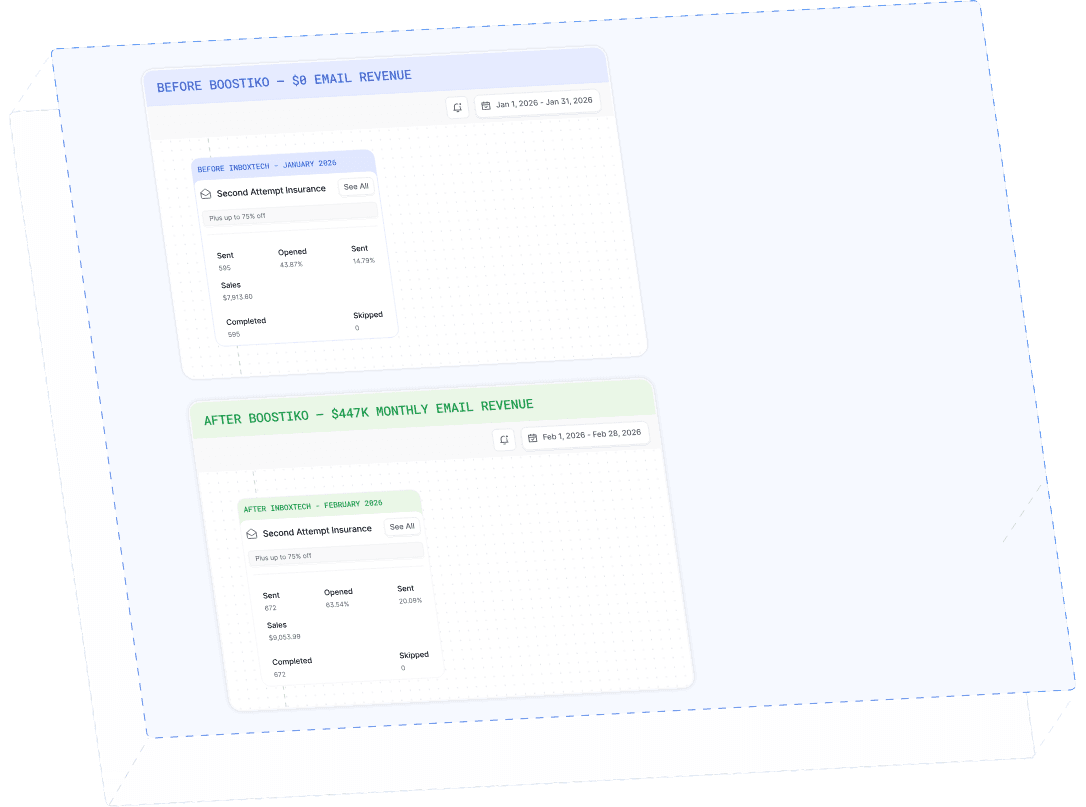
$0 - $447K in 3 months
40.7% of total revenue
14 days time to first revenue
$0 to $447,115/month in Email Revenue in 90 Days