•
Boostiko Team

Perpetual Prop Firm Email Marketing: Risk First Activation
Perpetual prop firm email marketing should help people understand the product, find the current rules, and get support. It should not turn every message into a promise about trading results, funding, or payouts.
That matters because perpetual contracts are not ordinary dated futures. The Commodity Futures Trading Commission explains that they have no fixed expiration date and commonly use a funding rate mechanism to keep their price close to the referenced spot market. The product can also involve leverage, margin, and liquidation thresholds. 1
A firm does not need to teach an entire derivatives course by email. It does need to make the next step clear. A new lead needs to understand what the program is. A buyer needs access instructions and the current rules. An active customer needs accurate account information, not a noisy promotion that competes with an important update.
This is a practical guide to the lifecycle behind that experience. It is not investment advice, legal advice, or a recommendation to trade. A perpetual prop firm needs its own qualified review for its product, jurisdiction, rules, disclosures, and communications.
Start with the product truth, not the campaign calendar
The most common lifecycle mistake is planning emails around discounts before the team has agreed on the product truth. The result is familiar: a welcome email says one thing, the rules page says another, support answers a third question, and a customer is left trying to work out which source is current.
For a perpetual prop firm, the source of truth should cover the actual model. Does the customer trade a simulated environment, a live environment, or another defined program? What account stages exist? Which rules apply to a given account type? How are funding, margin, fees, and liquidations described in the approved product materials? What changes if a product rule is updated?
The CFTC advises people considering crypto asset perpetual contracts to review rulebooks, contract specifications, and pricing mechanisms before trading, and to understand how leverage and margin affect liquidation thresholds. 1 A prop firm should not copy that wording into every email. It should make the firm’s own approved rulebook and product material easy to reach at the moment a customer needs it.
That means each email has one job. A message about account access should lead to account access. A message about a rule update should state the effective date, who is affected, and where the complete current policy lives. A marketing offer should be clearly separate from a service or account notice.
Build activation around real customer states
An email system works when it reacts to a real customer state instead of guessing intent from one open or one click.
A useful perpetual prop firm activation map starts with these states:
marketing subscriber with no program purchase
buyer waiting for account access
customer with access but no completed setup
customer using the program
customer who has asked a rules or support question
customer affected by a product or policy change
customer who has opted out of marketing
The labels can change. The principle should not. Every state needs a defined owner, an allowed message type, a current source of truth, and an exclusion rule.
For example, a buyer waiting for access may receive a confirmation message with account instructions and the support route. A person who has opted out of marketing should not receive a launch promotion simply because they opened an operational email. A customer who has an unresolved support request should not be placed in a generic urgency sequence.
This makes the system calmer and more accurate. It also gives the team a way to diagnose gaps. If many buyers do not complete setup, look at the access instructions and help content before adding another discount. If the same rule question appears in support, improve the approved explanation and the link path in the appropriate message.
A five message risk first activation sequence
A clear activation path can be short. The goal is not to fill a calendar. It is to help the customer take the correct next step with the information they need.
1. The product and access message
Send this after a valid sign up or purchase event. Confirm what the person signed up for, how access will be delivered, where the current program rules are located, and how to contact support.
Use a factual subject line such as “Your program access and next steps.” Do not use language such as “You are one trade away” or “Your payout journey starts now.” Those claims create pressure and may not match the actual product.
The message should make a clean distinction between product information and promotion. If it contains a commercial offer, treat it as commercial email and run it through the relevant review and consent controls.
2. The product mechanics explainer
Send this only where it matches the person’s program and the firm’s approved product material. The message can point to an explainer for perpetual contract mechanics, funding, margin, and risk. It should not offer a trading view or predict a result.
Keep the language plain. State that perpetual contracts do not have a fixed expiration date. Explain that a funding mechanism can be part of the product design. Direct the person to the current official rules for account specific details. Do not turn a generic explanation into a substitute for the rulebook.
This message lowers the chance that a customer assumes a perpetual program works like a dated futures product. It also gives support a consistent reference point when questions arrive.
3. The setup and status message
Send this after access is available or after a defined setup event. Show where the customer can view their current account status, use the platform, read the active rules, and request support.
Do not add a sales pitch to an account setup message. A customer who is trying to understand access does not benefit from an unrelated upgrade banner. Keep the operational path focused.
The same rule applies to status messages. If a system sends an account update, the content should start with the status information. Any marketing content must be reviewed separately because the message may be commercial based on its primary purpose.
The Federal Trade Commission says CAN SPAM applies to commercial email based on primary purpose. Commercial messages need accurate sender information, non deceptive subject lines, a valid postal address, and a clear opt out mechanism. 2
4. The rule or platform change message
Use a dedicated operational template when a rule, product feature, fee, platform process, or availability condition changes. The reader should be able to answer four questions without scrolling through marketing copy:
what changed
when it takes effect
who it affects
where the full current policy can be reviewed
Put a version number or effective date in the approved rule page. In the email, link directly to that source. Do not rely on a previous campaign explanation after a policy update.
If a firm markets crypto related products to UK consumers, the Financial Conduct Authority says the financial promotions regime can apply to a broad range of communications. The FCA requires relevant promotions to be fair, clear, and not misleading, with risk warnings and consumer journey friction in the applicable cases. 3 Whether a specific perpetual prop program or message is in scope is a question for qualified reviewers. The operational takeaway is simple: do not allow urgency copy to obscure material product information.
5. The support and preference message
Close the activation path with a message that makes support and preferences visible. Show the official support route. Explain how to manage marketing preferences. Keep the customer’s ability to get account help separate from their choice to receive promotions.
For UK individuals, the Information Commissioner’s Office says electronic marketing normally requires specific consent, subject to a limited soft opt in for a sender’s own similar products and existing customers. It also requires an opt out route and a valid sender identity. 4
The exact rule depends on the recipient and the market. Your system therefore needs a consent record that includes the source, time, wording, channel, and current preference. A campaign audience should be built from that record, not from a spreadsheet copied between teams.
Use a message classification rule before every send
Teams need a simple way to decide how a message should be treated. A useful internal question is: would a reasonable person see this as an account or product notice, or as an offer to buy, upgrade, renew, or engage with a promotion?
If it is an account or product notice, keep the operational content first. If it is promotional, make sure the audience, content, sender identity, unsubscribe handling, and review path are appropriate for a marketing send. When a message mixes both, the review should assume that the commercial content may determine the practical treatment.
This protects the customer experience. It also protects the brand from a common error: placing a compelling offer at the top of a message labelled as an account update.
A useful campaign brief has six fields:
purpose of the message
audience and consent basis
current product or rule source
approved claims and required risk language
owner and reviewer
suppression and support exclusions
The brief is small, but it stops old templates from being reused in the wrong context. It also makes it easier to prove which rule version and content block supported a particular send.
Do not use perpetual product language as urgency copy
Perpetual markets can run continuously. That does not make “act now” a good default for email.
Do not use funding rates, volatility, liquidation risk, or a market move as a reason to pressure a prospect into a purchase. Do not tell a customer that a program is likely to lead to profit, a funded account, or a payout. Do not use a countdown timer where the actual purpose is to make someone skip the product information.
The FCA warns that cryptoassets are high risk and says relevant promotions must be fair, clear, and not misleading. 3 Under MiCA Article 7, marketing communications within its stated scope must be clearly identifiable as marketing, fair, clear, and not misleading, and consistent with the relevant crypto asset white paper. 5
A perpetual prop firm may not fall into the exact legal scope of each rule. That is why a legal conclusion does not belong in an email strategy article. But the communication principle is durable: the customer should be able to understand the material information before being asked to act.
Deliverability supports the trust system
A clear message that lands in spam cannot support activation. Deliverability is not only a technical project. It depends on useful messages, a stable sending identity, valid permission, and good audience controls.
Google requires SPF or DKIM for all senders to personal Gmail accounts. Higher volume senders must use SPF, DKIM, and DMARC, align the From domain with SPF or DKIM, keep reported spam rates below 0.3 percent, and provide one click unsubscribe for marketing and subscribed messages. 6
For a perpetual prop firm, keep operational and promotional traffic distinct in your reporting. Monitor delivery, complaints, unsubscribes, bounces, and support volume by message type. A rising complaint rate on a promotion is not a reason to send another reminder. It is a signal to check consent, targeting, frequency, and expectation setting.
Use a stable From identity. Do not make customers guess whether an email came from support, a product team, or a campaign. When the sender identity is consistent, customers have a better chance of recognising legitimate operational messages and reporting suspicious ones.
Agency versus in house execution
The firm must own the things an agency cannot invent. That includes the program model, rules, product updates, legal interpretation, approved disclosures, support policy, and final approval.
The work around those inputs needs multiple capabilities. Someone has to map customer states, write emails, design them, build the automations, connect the data, protect deliverability, monitor results, and keep the operating process current. A single in house CRM manager may be asked to cover every one of those jobs.
Boostiko brings the design, copy, operations, technical build, and deliverability work into one lifecycle team. The perpetual prop firm keeps control of product truth and approval. Together, the teams build a system that gives customers clearer information and gives operators a reliable way to run it.
The Boostiko solution
Boostiko helps perpetual prop firms build email systems that prioritise product clarity before promotion. We map the activation journey, identify unclear rules and support gaps, separate operational and commercial messaging, build the email templates and automations, and establish the deliverability controls that keep important messages visible.
We do not promise trading performance, funded accounts, payouts, or returns. We help brands create clearer customer communication and a stronger lifecycle operation.
If your perpetual prop firm emails make customers search for the real rules, talk to Boostiko about a lifecycle and activation audit.
FAQs
What should a perpetual prop firm send after a customer signs up?
Send a factual confirmation, access instructions, the current program rules, and an official support route. Follow with product mechanics and setup information only when it matches the customer’s actual program.
Should funding rate or leverage content be used to push offers?
No. Use approved product explanations to help a customer understand mechanics and risks. Do not use market conditions, liquidation language, or funding rate references as pressure to buy or trade.
How should a firm communicate a rule change?
Use a dedicated operational message. State what changed, the effective date, the affected account types, the official source of truth, and the support route. Keep promotional content separate.
Does every perpetual prop firm message need the same risk language?
No. The relevant wording depends on the product, jurisdiction, audience, and legal review. Build controlled content blocks rather than copying one disclaimer into every campaign.
Can Boostiko approve legal or regulatory claims?
No. Boostiko builds lifecycle strategy and email operations. The client keeps responsibility for product rules, claims, legal and regulatory review, data use, disclosures, and final approval.
References
Continue reading


Case Study 01
Leading Prop Firm
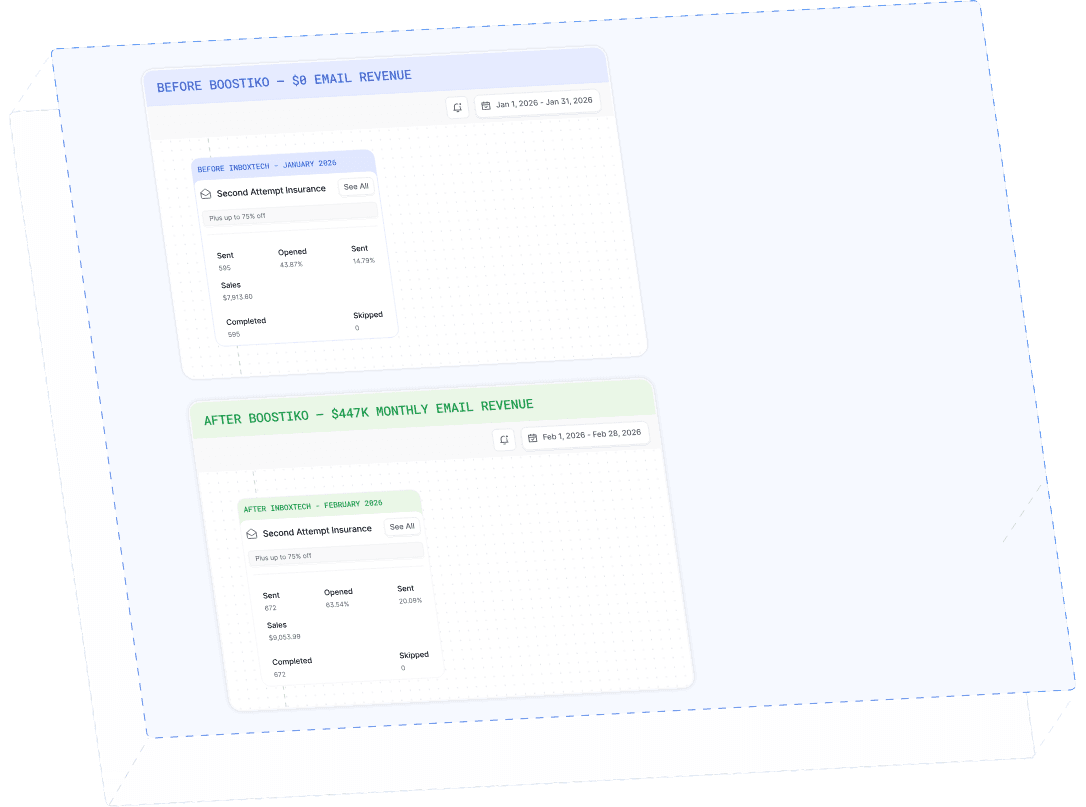
$0 - $447K in 3 months
40.7% of total revenue
14 days time to first revenue
$0 to $447,115/month in Email Revenue in 90 Days