•
Boostiko Team

Futures Prop Firm Payment Failure Emails: A Clear Recovery Flow
If a trader updates a card after a failed renewal but your CRM still sends an overdue reminder, the immediate problem is a billing discrepancy. The portal and the email are telling different stories. Updating a card does not necessarily settle an invoice, but a reminder must check what happened before asking someone to act again.
Futures prop firm payment failure emails should start with a verified failed attempt, identify the recovery step and stop when that request no longer applies. This is different from subscription renewal notices, which explain an upcoming charge. Recovery deals with a payment that did not complete, not a renewal that might fail.
Identify what actually failed
Before writing “your payment failed,” separate four situations.
A first purchase failure belongs to the original checkout process. Do not treat an unfinished checkout as an established subscription debt or assume an account was created.
A recurring renewal failure concerns an existing billing agreement and a specific invoice. Confirm that the invoice remains collectible before requesting payment.
An authentication requirement needs its own next step through the payment provider. It is not simply a reason to keep requesting a different card.
An invoice finalization failure can prevent collection before a payment attempt happens. Stripe documents this separately, and subscription access can remain active. Route an internal billing problem to the team responsible rather than calling it a card decline.2
Use a customer facing explanation only when it is reliable and approved. If the issuer reason is unknown, say the payment could not be completed. Do not guess “insufficient funds” or expose sensitive decline codes.
Build one recovery record per invoice
Keep the flow tied to the customer and invoice identifiers, not just an email address. One invoice may have several attempts. Those attempts do not represent separate debts or justify separate email sequences.1
Store the failure event, message history and resolution state against that record. Verify incoming webhook signatures, test the endpoint and handle repeated events without duplicating actions.2 Before sending, retrieve the current invoice state and any relevant subscription state. A queued message should not rely on the status captured when the failure first arrived.
Billing status also needs a clear boundary. An unpaid invoice is not an evaluation breach. A paid invoice is not proof of trading qualification, a payout entitlement or restored access. Those decisions belong to the firm's authoritative account and entitlement systems under its applicable policies.
A concrete Stripe implementation example
Stripe is one possible billing provider, not a standard used by every futures prop firm. For a Stripe subscription integration, verified events such as invoice.payment_failed can begin the reconciliation process. Authentication required events and subscription changes need separate handling.2
Stripe Billing supports Smart Retries and custom retry schedules. However, some failures, including missing payment methods and certain hard declines, cannot simply be retried automatically. Email timing must follow the configured policy and current invoice, not a universal retry count.1
If Stripe automations are enabled, next_payment_attempt is supplied through invoice.updated rather than invoice.payment_failed. Read the authoritative current state before mentioning another attempt. Do not promise a retry date from an old event payload.1
Payment method priority matters too. subscription.default_payment_method takes precedence over customer.invoice_settings.default_payment_method. Updating only the customer's default can leave the subscription trying the old method.1 Verify that your approved portal or integration updates the level used by the affected subscription. The customer should see a straightforward card update screen, not instructions to change API fields.
Keep recovery on the existing invoice. If a manual payment and an automatic retry could overlap, the portal should check the provider's current state and handle an in progress payment safely. Do not direct the trader to a new checkout or a replacement account.
Send a useful first notice
Once the failed attempt and unresolved invoice are confirmed, send a timely notice with one main action. Include the relevant plan, invoice reference, amount and currency only when those details are validated. Keep payment details out of the subject line.
This short excerpt is illustrative, not a real account message:
Subject: Your subscription payment needs attention
We could not complete the payment for your subscription. Open your secure billing portal to check the invoice status and follow the available recovery steps.
Button: Open secure billing portal
If you have already taken action, check the current status there before trying again. Reply to this email if you need help, but do not send payment details.
The button should lead to a trusted hosted portal and the correct invoice after any required authentication. Never ask for a full card number, CVV, bank password or one time code by reply. Support should be able to help without collecting those details.
Let current state control reminders
A later reminder can be useful near a genuine next retry or an applicable billing deadline. It should be conditional, not part of a fixed sequence that runs regardless of payment status. Provider retry scheduling and email scheduling are separate processes.
Check again immediately before dispatch. If the invoice is paid, voided, marked uncollectible or otherwise no longer collectible under the approved policy, suppress the payment request. Stopping messages does not mean rewriting the accounting history or claiming that every balance has disappeared.
When payment is processing, hold further payment demands while the result is reconciled. A repeated webhook, another attempt count or an event replay should not restart the flow. Cancellation also needs reconciliation: it may not settle a preexisting unpaid invoice.2
Pause escalation during a dispute, refund review or support investigation according to policy. Give those cases an owner rather than leaving the customer inside an unattended reminder loop.
If access may change, explain only the verified policy and current status. Do not threaten a trading ban, imply confiscation or pressure someone to deposit or trade to solve a billing issue.
Confirm payment without promising access
A success message should confirm the resolved billing item and remove the customer from its recovery queue.
In Stripe, invoice.paid is a billing success signal. Before extending access on that basis, retrieve the associated subscription and confirm that it is active. Other outstanding invoices or status issues may still require resolution.2 Check entitlements separately rather than assuming that payment resets an evaluation.
This second excerpt is also illustrative:
Subject: Your invoice is paid
Payment for this invoice is confirmed. No further payment action is needed for this invoice.
You can view the receipt in your secure billing portal. Check your account dashboard for access and evaluation status, or reply if those details need review.
For any subsequent futures prop firm onboarding emails, use the verified account state. A billing receipt should not quietly become an access approval.
Keep billing messages separate from promotions
Under US CAN-SPAM guidance, a message facilitating an already agreed transaction may qualify as transactional or relationship content, but classification depends on its primary purpose. That is not a blanket exemption for recovery emails. Keep coupons, upgrades and challenge offers separate. Commercial messages have requirements covering truthful headers and subjects, advertising disclosure, a postal address and opt out handling. Apply relevant local law and provider rules, and never use an operational message to bypass suppressed marketing permission.3
Use a stable, recognizable billing From address, a real support Reply-To and an accurate subject without fake “Re:” or “Fwd:” prefixes. Google's personal Gmail guidelines require SPF or DKIM for all senders, and SPF, DKIM and DMARC for bulk senders. Applicable bulk marketing and subscribed messages also need one click unsubscribe. Authentication supports sending hygiene but does not guarantee inbox placement; opens do not reliably prove delivery or readership.4
Test resolution, not just email rendering
Use internal test events and accounts without real charges or customer emails. Test duplicate delivery of the same event, multiple attempts on one invoice and payment completing while a reminder is queued.
Also test a card update at the correct payment method level, authentication required states, retryable failures and hard declines. Include canceled subscriptions with unresolved invoice policy, voided invoices, finalization errors and paid invoices with unresolved access. Each case should produce the appropriate message, suppression or support handoff.
Log only the operational identifiers needed for investigation, not sensitive payment data. Support needs visibility into the invoice, current state and messages already sent.
Measure unique invoices with verified billing resolution, time to resolution and recurring support problems. Separate automatic retry recoveries from email assisted activity. A payment after an email does not prove the email caused it, and open rates cannot substitute for a confirmed invoice outcome.
Where Boostiko fits
A payment recovery flow needs more than a template. Boostiko's five role package brings together a copywriter, designer, email operations specialist, technical integration specialist and deliverability specialist.
The work connects clear copy and usable email design with the actual billing backend: verified triggers, secure portal destinations, current state checks, suppression rules and support handoffs. Deliverability work supports that setup without promising inbox placement or recovered revenue.
If your billing portal and reminders are giving customers different answers, contact Boostiko to discuss a recovery flow that asks for the right action and stops when it is no longer needed.
References
Continue reading



Case Study 01
Leading Prop Firm
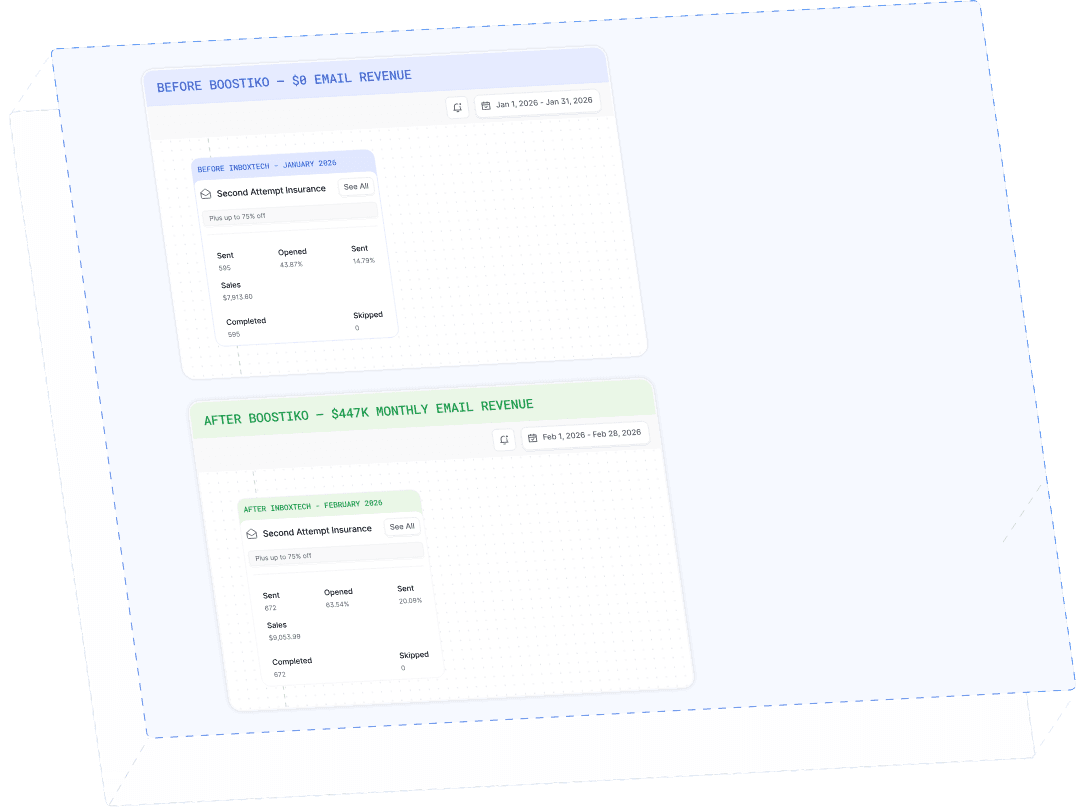
$0 - $447K in 3 months
40.7% of total revenue
14 days time to first revenue
$0 to $447,115/month in Added Revenue in 90 Days