•
Boostiko Team

Perpetual Prop Firm Winback Emails: Reconnect Without Trading Pressure
A previous customer can go quiet without deciding to leave. They might be taking a break, comparing options or waiting until they have time to read the current terms. Silence does not tell a prop firm which explanation is true.
Perpetual prop firm winback emails should make reconnecting easier, not turn that uncertainty into pressure. The aim is to offer something useful to an eligible customer who can receive marketing, then step back if they return, reply or opt out.
That makes winback a lifecycle marketing project rather than another account notice. Good email marketing for perpetual prop firms connects audience selection, helpful copy and reliable exit rules. A friendly message cannot compensate for sending it to the wrong person.
Define inactivity without guessing intent
Start with a written audience definition. An inactive customer has passed a relevant period without a verified action that matters to the campaign. That definition should come from the firm's customer journey, not a convenient dashboard filter.
No recent logins does not prove lost interest. Someone may still have an active account, an unresolved question or no reason to visit the portal. Email opens are also a weak foundation for selection because privacy features can inflate them.
Keep inactivity separate from eligibility. A former customer might be inactive but unable to purchase under current firm policies. A suppressed or unsubscribed profile should not enter the marketing audience, even when its purchase history looks suitable.
Likewise, a canceled account, a breach or a resolved support case is not an automatic invitation to buy again. Establish whether marketing is appropriate before considering an offer. Never frame another purchase as a way to recover losses or repair a breach.
Record why each customer qualifies, which event started the waiting period and which checks must still pass before delivery.
Build the trigger around real firm events
Klaviyo's winback guide illustrates an ecommerce flow triggered by Placed Order, with a delay slightly beyond the normal buying cycle and a filter that excludes people who order after entering. Those are provider specific mechanics, not events every prop firm automatically has. 1
For a prop firm, first identify a reliable paid purchase event and its relationship to the customer and account records. If the integration does not expose Placed Order, use an appropriately collected equivalent only after verifying its meaning. A checkout visit or account creation is not a confirmed paid purchase.
Base timing on the firm's normal buying cycle where one can be established. Do not borrow a replenishment schedule from retail or assume every customer should purchase monthly. If the pattern is unclear, test a small eligible audience conservatively rather than presenting a universal interval as best practice.
Keep winback separate from perpetual prop firm account renewal emails. A required account action needs its own accurate explanation; it should not become a promotional message disguised as maintenance.
Test a short sequence with a useful reason to write
A cap of two to three messages is a sensible test strategy, not a mandatory schedule. Set the first delay and spacing around the verified buying cycle, customer context and other messages the person receives.
The first email should offer a practical route back to information or help. That might be an existing terms page, a genuine published update or a monitored reply address. Mention an update only when the team has confirmed what changed and whom it affects.
A second message can answer a common question that support actually receives. An optional third can close the sequence politely, without suggesting the customer owes the firm a decision. If there is nothing new or helpful to say, stop at two.
Do not make a discount the default reason to reconnect. Any incentive needs approval, accurate eligibility and clear terms. Fake countdowns, invented scarcity and prompts to deposit or trade more do not belong in this sequence.
Two illustrative email excerpts
These excerpts show tone and structure, not facts about a particular firm. Use the first only if the linked information is current, and the second only when replies reach a staffed inbox. Each full email still needs the appropriate identity and unsubscribe footer.
Illustrative email one: information without a push
Subject: Questions before you reconnect?
If you're considering returning, you can review the current terms on our website before deciding. If anything is unclear, reply with your question and our team can point you to the relevant information.
There's no need to make a decision today.
Link: Review the current terms
Illustrative email two: a human way to ask
Subject: Can we help with a question?
You might be taking a break, and that's fine. If a question about the information on our website is holding you up, reply here and we'll help you find the answer.
If now isn't the right time, you can leave it there. You can also unsubscribe from marketing using the link below.
Reply: Ask a question
Neither excerpt promises trading outcomes or assumes the recipient wants another account. Both leave room for an informed choice.
Recheck eligibility before every send
Passing the entry filter is not enough. During a delay, someone can purchase, return, unsubscribe or raise an issue. Recheck account state, customer eligibility, consent, suppression and current orders immediately before each send.
Define what counts as a resolved return. It could be a confirmed eligible paid order or another verified action that makes the invitation unnecessary. Do not treat an open as a return. Once the customer has returned through the defined event, suppress the remaining sequence and route them to the appropriate journey.
Use current order records to avoid prompting someone who has already purchased or whose payment is being processed. If account eligibility changes, a cancellation or refund appears, or a support issue needs attention, stop the marketing sequence pending review.
A real reply should stop the automated sequence and reach a named team or queue. Staff need context, an owner and a clear next step, not an unattended mailbox. An automatic reply should not be mistaken for a human response.
When a conversation needs service rather than marketing, use an appropriate support follow up process. Resolving that issue is not permission to restart winback automatically.
Keep permission and delivery checks practical
Klaviyo distinguishes suppression from consent: a subscribed profile can still be suppressed and unable to receive marketing. Preserve both records when moving platforms. Do not bypass an opt out through a new list, manual enrollment or automatic unsuppression. Technical reachability is not blanket legal permission. 2
Winback promotion is commercial email, even when sent to a former customer. The FTC's CAN-SPAM guidance covers accurate headers and subjects, required advertising identification, a postal address and a clear opt out. Honor requests promptly; the US maximum of ten business days is a ceiling, not a target. Apply relevant local rules and the provider's consent policy too. 3
Delivery setup matters alongside permission. Gmail requires SPF or DKIM for all senders, with SPF, DKIM, DMARC and alignment for bulk senders. Applicable bulk marketing email also needs one click unsubscribe and a visible body link. Use a truthful, stable sender identity rather than fake reply prefixes. Authentication does not guarantee inbox delivery. 4
Measure confirmed returns, not attractive dashboards
Choose the outcome before launch. For a purchase focused test, measure confirmed eligible paid orders and net paid revenue after refunds and cancellations over a defined observation period. Deduplicate records so one order does not become several conversions through repeated events.
Report completed purchases separately from checkout activity, clicks and replies. Those signals can explain customer behavior, but they are not interchangeable with revenue. Opens should not decide whether someone remains inactive or whether the sequence worked.
Include unsubscribes, complaints, delivery failures and support issues in the review. A sequence that generates orders while creating avoidable confusion needs improvement, not just a stronger subject line.
Attributed purchases are not automatically caused by the emails. Customers may have returned anyway or seen another campaign. Where audience size permits, consider a randomly assigned eligible holdout that receives no winback sequence, while both groups continue receiving necessary service messages. Compare outcomes over the same period and acknowledge small samples and other influences.
Test one meaningful variable at a time. Keep eligibility rules stable so a copy test does not accidentally become an audience test.
Check the journey before launch
Walk through a qualifying customer, a new purchaser, an unsubscribe, a suppressed profile, an ineligible account and a human reply. Confirm that each takes the expected route and that the remaining sends stop when they should.
Check links, mobile readability, reply routing and event delays. Assign someone to review exceptions after launch. Document the message cap and any later reentry policy so a quiet customer does not cycle through the same invitation indefinitely.
Where Boostiko fits
Perpetual prop firm winback emails need more than copy placed inside a template. They need a team that can connect a respectful invitation with accurate customer data and dependable operations.
Boostiko brings the full team together: a copywriter shapes useful messages, a designer makes them clear and readable, operations owns approvals and reply handling, technical integration connects verified events and exit checks, and deliverability reviews sender setup, suppression and unsubscribe behavior.
That coordinated approach makes email marketing for perpetual prop firms easier to manage without turning customer silence into trading pressure. If you need help building or reviewing this lifecycle journey, contact Boostiko to discuss your audience, systems and practical next steps.
References
Continue reading



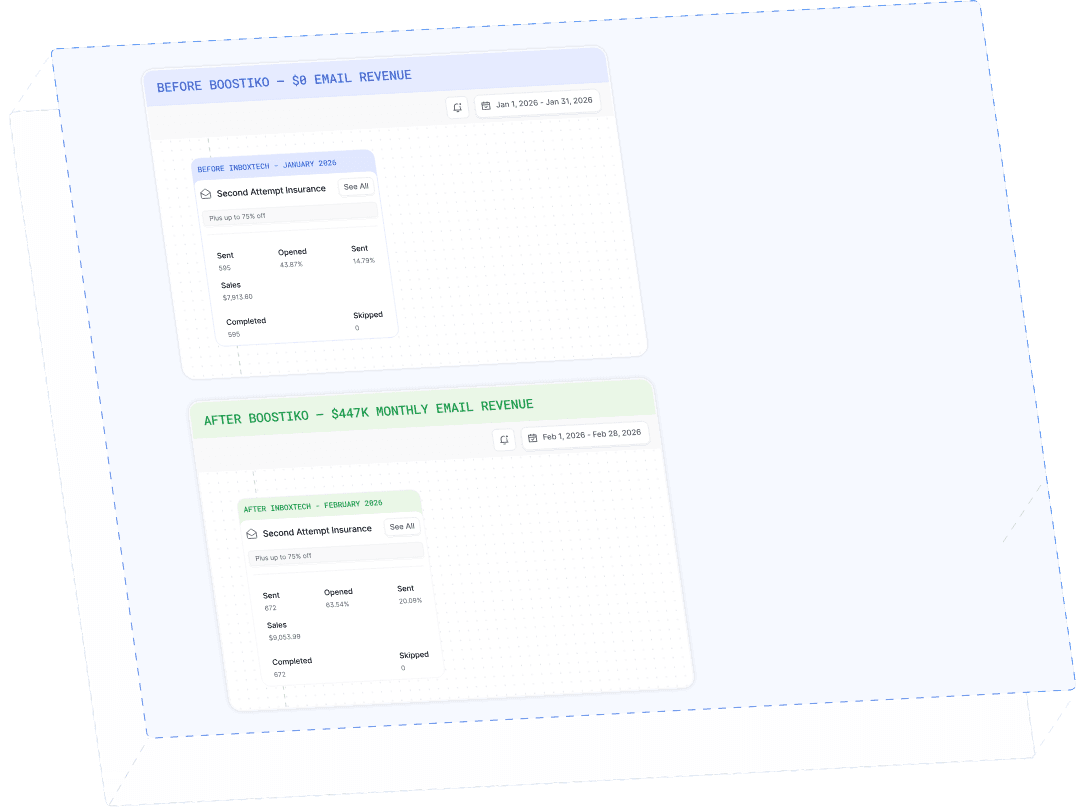
Case Study 01
Leading Prop Firm
$0 - $447K in 3 months
40.7% of total revenue
14 days time to first revenue
$0 to $447,115/month in Added Revenue in 90 Days