•
Boostiko Team

Crypto Prop Firm Email Segmentation: Match Messages to Account Stage
A subscriber comparing account options does not need the same email as someone who paid yesterday. An active customer may need information about an existing account, while a former customer may not want another promotion at all. Sending everyone the same offer ignores those differences.
Useful email marketing for crypto prop firms starts with a simpler question: what message makes sense for this person now? Practical crypto prop firm email segmentation helps answer it, but only when the underlying data is reliable. Consent, current eligibility and product availability still come first. The goal is relevant communication, not another reason to push someone toward trading or purchasing.
Define stages your firm can actually verify
Start with the customer states that exist in your business, not a generic funnel diagram. A firm might distinguish newly subscribed prospects, newly paid customers, active accounts and past customers. Use these categories only if your systems can identify them accurately. A firm without a verified paused state should not invent one from a quiet inbox.
A newly subscribed prospect could mean someone with a recorded email subscription and no confirmed paid order. Define what “newly” means for your welcome sequence. The subscription timestamp is the source for entry; the order system determines whether the person is still a prospect. A downloaded guide or crypto preference does not reveal trading intent or risk tolerance.
A newly paid customer needs a confirmed payment record, not merely a checkout visit. Choose an onboarding window appropriate to your service. Do not assume payment means an account is already available: provisioning, verification or other requirements may remain outstanding. Keep those facts separate so the message describes the actual next step.
Active account status should come from your account platform, with eligibility checked separately. Past customer status needs a defined historical relationship and no currently active account under your chosen definition. One person may own several accounts, so decide whether a campaign concerns a particular account or the overall customer. These are practical definitions to agree internally, not universal industry stages.
Give each field a source of truth
Document where subscription status, paid orders, account status and product eligibility originate. Include update timestamps and an owner responsible for resolving discrepancies. A marketing profile should carry useful signals from those systems, not silently become the authority on everything.
In Klaviyo, lists are membership collections and segments are dynamic groups built from conditions. Segments can draw from all account profiles, including people without marketing opt in, and updates are not always immediate. Segment membership is therefore neither permission nor a real time account ledger. 1
If payment data says “customer” while an old marketing property says “prospect,” hold the account specific promotion until the discrepancy is resolved. Missing information is not evidence of inactivity or interest. A permissioned subscriber with unknown account state might still receive general information within their chosen scope, but not an offer whose eligibility you cannot verify.
Separate subscription from technical reachability
Build the marketing audience around recorded email subscription, with applicable legal requirements and provider rules reviewed separately. An address existing in Klaviyo, appearing on a list or being technically reachable does not establish marketing consent. Email and SMS consent are also separate. 1 2
Klaviyo’s “Can receive email marketing” condition can include never subscribed profiles. Narrow it with “Because person subscribed,” then combine the relevant stage conditions using AND. Check actual suppression, exclusions and any list specific handling. An OR branch must not create a route around the subscriber requirement. 2
A purchase or historical account relationship should not automatically enter your marketing audience. Preserve unsubscribes and suppressions when importing customer data; do not use an account update to resubscribe or unsuppress someone. 2 Under CAN-SPAM, an existing membership does not remove marketing opt out rights, and commercial email to former customers still falls within commercial promotion. 4
Explicit preferences help refine a valid audience without guessing. Someone might choose product explanations but decline promotional offers. Your crypto prop firm email preference center can make that distinction clearer. Preferences should narrow the communication people receive, not override an unsubscribe.
Match the message to current needs and availability
For a subscribed prospect, explain available account options, relevant terms and how to compare them. Keep claims grounded in current products. A useful invitation is to review the details or ask a question, rather than act before an invented deadline.
For a newly paid customer, focus on getting oriented. Explain where to find account information and support, with operational steps sent through the appropriate service process. Marketing content, if permissioned, should complement that experience instead of promoting the purchase they just completed.
Active customers may benefit from information relevant to their existing service. Former customers might appreciate a genuinely applicable product explanation, but only if they remain subscribed and eligible. Neither group should receive language encouraging another purchase to recover losses, or messages interpreting account outcomes as readiness to trade again.
Check current availability, jurisdiction and account restrictions before selecting an offer. If access differs between customers, use the verified eligibility record rather than a broad crypto interest tag. The same discipline applies to crypto prop firm market access update emails: communicate what is actually available to the recipient, not a generic opportunity.
Set campaign priority before audiences overlap
A person can qualify for a welcome campaign, a product announcement and an onboarding sequence at once. Set a priority rule rather than letting each campaign owner treat their send as essential.
Necessary service communication should stay in its own process. Within marketing, prioritize the most relevant current stage message over a broad promotion. If a customer has just paid, exclude them from a prospect purchase campaign. If an unresolved eligibility issue makes an offer unsuitable, pause that offer even when the profile otherwise qualifies.
Use a shared marketing frequency limit across campaigns and automated sequences. Choose a starting cadence based on subscriber expectations and the amount of genuinely useful content, then review it. A preference for fewer messages should reduce sends. Quiet inbox behavior should not trigger extra pressure, and necessary operational alerts should not become an excuse for additional promotions.
Recheck state close to the send
Review permission, suppression, account stage and offer eligibility again close to dispatch. Klaviyo’s dynamic segments can lag behind underlying changes, so an audience checked yesterday may not reflect a payment or status update today. 1
Make this check especially important for scheduled promotions after a launch, account migration or data outage. Refresh the relevant source data, apply exclusions and confirm campaign handling with your technical owner. Where trustworthy current state is unavailable, hold the affected offer instead of assuming the old segment is correct.
A hypothetical contrast
Imagine a firm with verified subscriber and paid order records. Both people below have subscribed to marketing, but only one has purchased. These illustrative excerpts describe no real product change or performance result.
For the prospect: “Still comparing account options? Review the current terms and availability before deciding whether any option suits your needs. Reply if you would like clarification.”
For the newly paid customer: “You can find the account information guide and support details here. If anything is unclear, reply with your question. There is no need to choose another account to use this guide.”
The distinction is practical: one message supports evaluation, while the other supports understanding. Neither assumes trading plans or pressures another purchase.
Keep commercial and operational email distinct
An account status, security or fulfilment notice is not automatically marketing, but a CRM label does not decide its legal treatment. CAN-SPAM distinguishes messages by their primary purpose. Adding a promotion to an account email can affect that assessment. Commercial messages require accurate headers and subjects, a postal address, required advertising identification and a clear opt out mechanism. 4
Keep necessary service alerts focused on their actual purpose. Do not route promotions through that channel to reach unsubscribed customers. Review applicable local law and provider policies rather than treating the US framework as universal.
Google’s sender guidelines apply to personal Gmail accounts. All senders need SPF or DKIM; bulk senders need SPF, DKIM and DMARC, with the required alignment. Bulk marketing and subscribed messages need one click unsubscribe and a visible unsubscribe link in the body. 3 Google also recommends consistent sender identities and avoiding promotions in sales receipts. Authentication and segmentation do not guarantee inbox placement. 3
Measure useful outcomes, not just activity
Track delivered recipients, valid clicks and replies alongside actual paid orders. Exclude cancelled and fully refunded orders from completed purchase reporting, and adjust net revenue for partial refunds. Review unsubscribes and complaints as evidence about relevance and frequency, not just acquisition cost.
Do not judge stages exclusively by opens. Inspect what recipients actually did and whether replies reveal confusion. To evaluate segmentation, compare it with a suitable broader eligible audience using a matched offer and send window, keeping copy changes separate where possible. Audience differences can affect results, and attributed revenue is not proof that segmentation caused the purchase.
Agency or in house ownership
An in house team can own this work when it has the capacity to manage data, copy, design, campaign operations and deliverability. An agency can supply coordinated specialist support when those responsibilities compete with other priorities. The useful comparison is scope and accountability, not an assumption that every firm needs five full time hires.
Where Boostiko fits
Boostiko packages a designer, operations support, technical specialist, copywriter and deliverability expert for the price of one in house hire. That model brings the disciplines behind relevant segmentation into one service, while your firm remains the authority on account status and eligibility.
If your campaigns need clearer audiences and more useful messages, contact Boostiko to discuss a practical email plan built around verified customer stages.
References
Continue reading



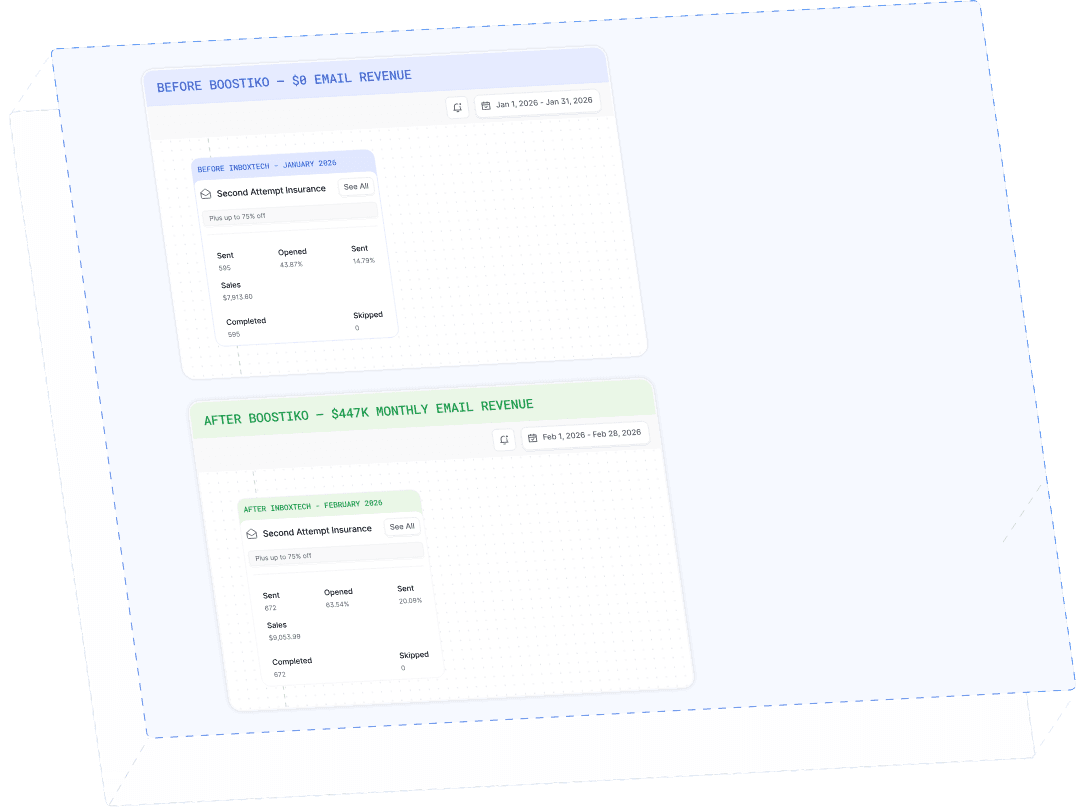
Case Study 01
Leading Prop Firm
$0 - $447K in 3 months
40.7% of total revenue
14 days time to first revenue
$0 to $447,115/month in Added Revenue in 90 Days