•
Boostiko Team

Perpetual Prop Firm Email Attribution: Report Revenue Without Counting It Twice
An email dashboard can assign revenue to a renewal reminder while another platform credits the same purchase to paid search. Both reports may follow their configured rules. The firm still collected one fee.
Reliable perpetual prop firm email attribution starts with that distinction. You need a record of what customers actually paid, a documented explanation of how messages receive credit, and a separate method for testing whether optional marketing caused additional purchases. Combining those questions into one headline makes campaign and flow decisions harder, not easier.
1. Decide which revenue question the report answers
Collected fees, attributed revenue and incremental lift are different measures.
Collected fees describe customer payments on the basis approved by finance. Attributed revenue describes purchase value assigned to a campaign or flow under a platform's rules. Incremental lift estimates the additional outcome compared with what would have happened without the marketing treatment.
Use attribution to compare campaigns and flows under consistent settings. Use payment records to reconcile collections. Use a controlled comparison to investigate lift. A click followed by a purchase can qualify for platform credit without proving that the message caused the purchase. Klaviyo and Google Analytics describe attribution as assigning credit to eligible interactions, not as a substitute for that comparison. 1 2
For email marketing for perpetual prop firms, label the reporting question before choosing a dashboard. “Email attributed renewal fees” is more precise than “revenue generated by email.”
2. Capture a real purchase, not a nearby action
Define the business conversion event before connecting it to reports. A confirmed paid purchase is not the same event as an account creation, checkout click, submitted payment form or pending payment. Decide which payment state qualifies and make the integration enforce that decision.
Keep a unique business order ID and the relevant payment transaction ID. If a webhook retries or an integration replays historical records, those technical deliveries must not become fresh purchases. Use replay safe processing and retain enough identifiers to trace the event back to the paid transaction.
Do not deduplicate by email address. One trader can legitimately buy multiple evaluation accounts. Separate purchases need separate order records, even when the customer is the same.
Test a failed payment, a repeated event and two valid purchases by one customer before relying on campaign totals. The expected result is no purchase for the failure, one purchase for the retry and two for the distinct orders.
3. Give each purchase a finance approved value
The event value should represent the qualifying customer fee, not an evaluation account's notional balance. Trading profit and loss, displayed capital and trader payouts are not automatically revenue from customer purchases.
Preserve the original amount, currency, current transaction value or status, transaction timestamp and source. Keep refunds linked to the original paid transaction, including partial refunds. A refund or status update must not be replayed as a new purchase.
Have finance approve whether the report shows gross sales, collected fees or fees net of refunds. State the refund cutoff, treatment of adjustments and currency conversion policy. Do not add amounts in different currencies without an approved conversion basis.
A purchase event and a later refund may appear in different periods. Decide whether the reconciliation adjusts the original purchase cohort or reports the refund in its processing period. Neither convention should be hidden behind an unlabeled “revenue” total.
4. Check the Klaviyo metric, not just its name
Confirm the actual conversion metric used in each campaign or flow report. A custom event called “Purchase” is only useful if its trigger, identifiers and value match the agreed business definition.
Klaviyo's account level mapped metrics let integrations associate source metrics with references such as revenue, orders, cancellations and refunds. Revenue events must contain a value. These mappings affect specified areas, including benchmarks, predictive analytics, A/B testing and certain advanced reports. They are not a universal reporting setting. 3
Klaviyo identifies areas such as the conversion overview dashboard, audience performance and RFM as unaffected by mapped metric changes. Inspect the selected metric and report behavior rather than assuming every revenue figure changed with the mapping. 3
Mapping a refund metric also does not guarantee that every report automatically deducts refunds. Check what the displayed amount includes, then reconcile refund adjustments explicitly against payment records.
5. Record the attribution rules and reporting clock
Document the account's actual attribution model, eligible windows and whether opens, clicks or both can qualify. Klaviyo describes a default last touch approach, but the applicable channel settings must be inspected in the account. Do not copy an assumed window from another firm's setup. 1
An open eligible policy can assign credit without a click. That is a reporting rule, not proof of deliberate purchase intent. Record applicable privacy and bot filtering settings, and do not assume tracking captures every interaction.
Date grouping matters too. Campaign and flow dashboards can group attributed purchases by message send date, while metric reporting can group them by event date. A message sent near month end may receive credit for a purchase made in the next month. Account timezone can move boundary transactions between periods. 1
Record the date basis, timezone and export time. Allow for late events and processing before closing the report. Attribution setting changes can recalculate historical Klaviyo data, so previously exported totals may need a documented restatement. 1
6. Keep Klaviyo and GA4 as separate views
Use approved campaign identifiers and consistent link tags without putting personal information into URLs. Then compare Klaviyo and GA4 as views of the same purchases, not as amounts to add together.
An order may receive email credit in Klaviyo and another channel's credit in GA4. That remains one order. A combined channel report needs one approved policy with mutually exclusive assignments or weighted allocations that do not repeat the full purchase value across channels.
GA4's reporting attribution model affects event scoped traffic dimensions, including source, medium and campaign. User and session scoped dimensions are not affected in the same way. Data driven attribution can allocate fractional credit across interactions. Do not assume every GA4 report uses identical attribution behavior. 2
Also distinguish settings changes: GA4 reporting model changes apply to historical and future data, while key event lookback window changes apply going forward. Align definitions and periods before diagnosing disagreement as a tracking fault. 2
7. Separate automatic renewals from new purchases
Keep new customer purchases, renewals and reactivations visible as separate cohorts. A flow with substantial renewal credit may be reaching customers who were already scheduled to pay.
Consider a hypothetical opted in account holder who receives a renewal message, clicks it and then completes a scheduled renewal payment. The fee can qualify for attribution under the selected settings. That does not establish that the renewal would have failed without the message.
The report should describe an attributed renewal fee, not proven additional revenue. Review delivery and click behavior alongside billing state, cancellation status and purchase records.
Keep message purpose visible as well. Perpetual prop firm account renewal emails support a different customer situation from perpetual prop firm offer emails. Combining both into one total can conceal which flow is helping customers and which offer deserves further testing.
8. Reconcile monthly and preserve the snapshot
Start the monthly reconciliation with the approved payment ledger. Establish unique paid order counts and fee amounts by product and cohort. Apply the agreed currency and refund basis before comparing attributed totals.
Match marketing purchase events to order and payment IDs. Investigate duplicate events, missing purchases, wrong values, failed payments counted as purchases and unmatched refunds. Keep an exception count and assign each unresolved issue an owner. Marketing exports should omit unnecessary personal information.
Next, present the attributed campaign and flow figures with their platform, metric, model, windows and date basis. Compare trends only under a consistent policy, or label the break when settings change.
Archive the export and settings snapshot. Mark totals provisional until the chosen event lag and refund cutoff have passed. Keep a change log showing the reason, affected period and revised figure for each restatement.
Alongside payment tests, check currency handling, timezone boundaries, renewals, refunds and late interaction events using safe test records without sending real customer emails.
9. Test lift before making a causal claim
To investigate incremental fees, plan a controlled comparison among customers eligible to receive optional marketing. Use comparable account states and observation periods, define the purchase outcome beforehand, and include refunds on the agreed basis.
Do not withhold essential billing, risk or security notices, or required disclosures. The holdout should concern optional marketing. Small groups, incomplete tracking and differences between groups can limit what the result supports. Report uncertainty rather than turning an inconclusive test into a success story.
For public performance claims, separate verified collections, platform attributed credit and measured incremental outcomes. The FTC's advertising substantiation policy requires a reasonable basis for objective express or implied claims before publication, with support appropriate to the claim. 4 An attribution export alone should not be presented as proof of added revenue.
10. Where Boostiko fits
Boostiko can help connect email strategy, flow copy and reporting requirements so that each message has a clear purpose and each performance figure has a clear definition. That work includes collaborating with the firm's technical and finance owners on purchase events, renewal cohorts and reporting checks.
If your dashboards currently tell different revenue stories, contact Boostiko to discuss a measurement approach that makes campaign decisions easier without counting the same fee twice.
References
Continue reading



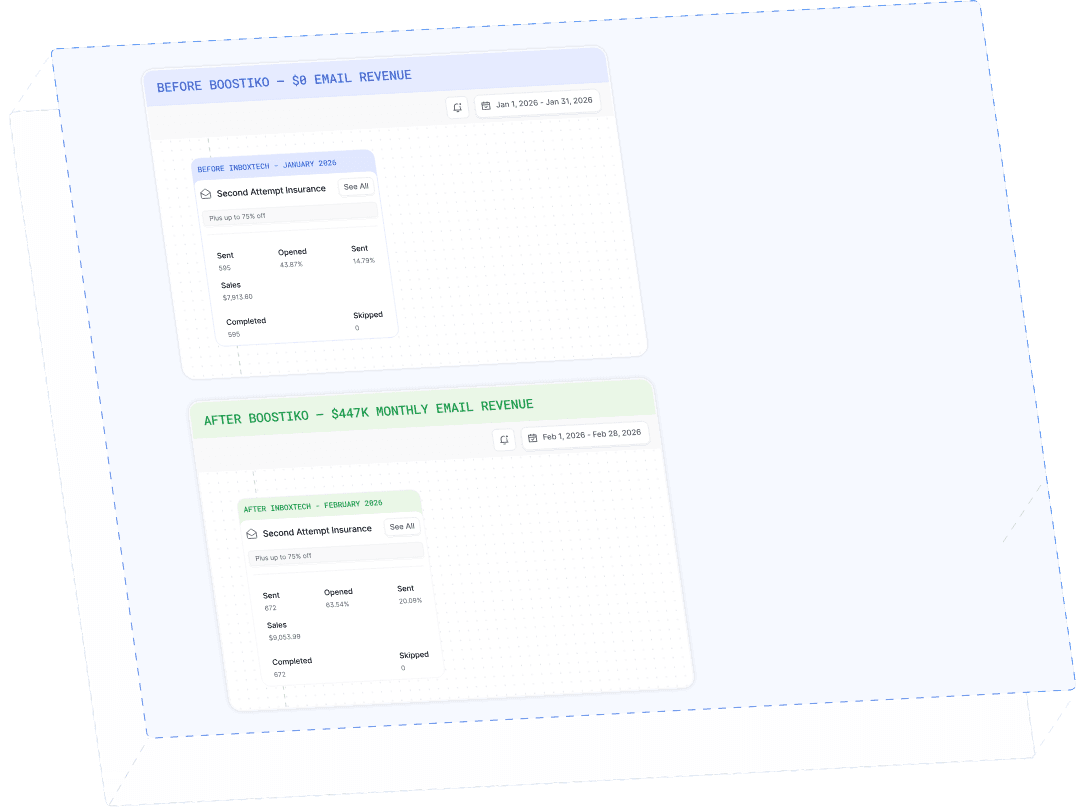
Case Study 01
Leading Prop Firm
$0 - $447K in 3 months
40.7% of total revenue
14 days time to first revenue
$0 to $447,115/month in Added Revenue in 90 Days