•
Boostiko Team

A customer buys an evaluation. For the next month, every email asks them to buy another one. Meanwhile, they cannot find an explanation of holding costs, a platform change or the rules for their account.
Retention marketing for perpetual prop firms should close that gap. It gives existing customers useful information about the product they have, then sends relevant campaigns when there is a genuine reason to do so. It is not an acquisition calendar with a different audience.
The first job is deciding what customers need to know after checkout. For a perpetual product, that includes how the account works, what can change and where to check the current terms.
Explain the product customers actually bought
The word “perpetual” does not tell an email team how the whole service works. An exchange contract, a simulated evaluation and a payout eligible account can have different mechanics. Campaign copy needs to reflect the actual product, not a generic definition borrowed from a trading venue.
Coinbase International Exchange explains that funding helps keep perpetual prices aligned with the index. Positive funding means longs pay shorts; negative funding means shorts pay longs.1 That describes its exchange funding mechanism. It does not establish the fees or settlement rules for every prop firm's evaluation.
Breakout provides a different, concrete example. Its published rules describe simulated capital, an evaluation with no payouts and a separate daily swap fee charged in six intervals. After passing, eligible traders move to a new demo account following the required verification and agreement steps.2
Those are provider specific terms. They show why the email team needs an approved product brief. Record the account model, holding cost calculation, relevant limits and payout conditions before writing the campaign. Do not call every charge a funding payment or imply that passing an evaluation guarantees live capital or a payout.
Our perpetual prop firm activation guide covers the first product explanation. Retention keeps that explanation current as the customer relationship continues.
Turn product changes into clear customer updates
A rules change should not get lost between two discount campaigns. Give it a separate communication plan.
Before writing, confirm which products and account versions are affected, whether existing accounts keep earlier terms and when the change takes effect. A message about a new plan should not suggest that every customer has been moved onto it.
Use one approved explanation across email, the dashboard and support. The email should state what changed, who it affects and where to read the full details. Link to the authoritative page rather than copying a long rules document into a template that may become outdated.
For a hypothetical holding cost change, a subject such as “Your account's holding cost terms are changing” is more useful than “Big news for traders.” Only use that subject when the recipient's account is actually affected. Explain the effective date and the management or support route without using the update to push a purchase.
Check queued messages too. Pause an older education sequence if it contradicts the new terms. Keeping campaign copy accurate includes stopping yesterday's automation, not just publishing today's announcement.
Use education to answer real questions
Start with questions support receives repeatedly. Can customers find their current cost terms? Do they understand which limits apply to their plan? Do they know where to check whether a platform issue has been resolved?
Build short campaigns around those questions. A holding cost explainer can show where the customer sees the calculation and which period it covers. A rules email can point to the correct account page. A platform walkthrough can help customers find a feature they already have access to.
Use reviewed examples with clearly stated assumptions. Do not imply that one exchange's funding example applies to your simulated account. If a calculation depends on direction, size or time, explain the inputs and get the team responsible for the product to approve it.
The useful action is understanding the account, not opening more positions. Avoid messages that use a market move, a loss or an account breach to urge immediate trading or another evaluation purchase.
Choose the audience before choosing the offer
A broad “past buyer” segment can contain people on different plans, closed accounts, customers awaiting verification and customers with unresolved complaints. They should not all receive the same message.
For each campaign, define the product, account stage, eligibility and marketing permission. Record who is excluded. Keep account identifiers available so a person with multiple accounts is not treated as if every account has the same status.
A new feature announcement can go to customers whose product includes the feature. An optional tutorial can go to eligible subscribers who want educational content. A promotional offer needs its own approved audience and current terms.
Use a shared marketing frequency limit so campaigns do not collide with automated offers. When a customer has an unresolved access issue or refund request, pause inappropriate sales messages and let support handle the problem first.
Our perpetual prop firm offer email guide covers the offer itself. Retention planning decides whether that offer belongs in the customer's inbox at all.
Keep service updates separate from promotions
A necessary account notice and an optional marketing campaign have different purposes. Make the distinction before adding an email to the calendar.
UK ICO guidance says purely administrative or customer service messages without promotional material are not direct marketing. Adding promotional content makes them marketing, even when the main purpose is administration.3 A discount at the bottom of a terms update is not simply decoration.
The ICO also says unsolicited email marketing to individual subscribers requires consent or a qualifying soft opt in.4 That is UK guidance, not a universal permission rule. Apply the consent, financial promotion and eligibility requirements relevant to your firm and audience.
Keep service communications factual. Respect marketing unsubscribes across every campaign and promotional flow. Do not use an account notice as a way to reach people who opted out of offers.
Give the campaign a useful next step
One message should make one action easy. A product update leads to the current terms. An education email leads to the relevant guide. A support message leads to a team that can resolve the question.
Do not promise help through a reply address nobody monitors. Assign an owner and give support enough account context to understand the issue, while keeping sensitive documents and credentials out of email personalization.
Ask whether the campaign was useful. Review repeated questions after sending. If customers still misunderstand the same charge or condition, improve the explanation before adding more reminders.
For commercial tests, compare eligible groups over the same period. Keep required service notices and normal support available to both groups. Measure retained customer relationships and net receipts after refunds, not just purchases credited to an email platform. Our perpetual prop firm email attribution guide explains how to avoid counting revenue twice.
Make delivery part of the campaign plan
Relevant content still needs a responsible sending setup. Check authentication, complaint handling, invalid addresses and unsubscribe controls before increasing volume.
Google's personal Gmail sender requirements include SPF or DKIM. Its bulk sender rules require SPF, DKIM and DMARC, with additional alignment requirements. Applicable bulk marketing and subscribed messages also need one click unsubscribe and a visible unsubscribe link.5
Boostiko's InboxTech™ is proprietary software designed to improve deliverability and help managed emails reach Gmail Primary rather than Spam or Promotions. Our published figures report a 44.8% open rate lift and a 35.8% click rate lift.6 These are engagement lifts, not inbox placement percentages or a result specific to perpetual prop firms. They do not forecast performance for your account, and Gmail still decides placement for each recipient.
Delivery work should support a useful campaign. It cannot turn an irrelevant offer or incorrect product explanation into good retention marketing.
Build a calendar around customer needs
A retention marketing agency for perpetual prop firms should bring product understanding, segmentation, creative and delivery together. The calendar should follow the customer relationship, not a fixed demand to send another promotion every week.
Boostiko helps trading brands plan lifecycle messages, write and design campaigns, connect relevant customer data and improve delivery with InboxTech. Start with a campaign your existing customers need: a clear product update, a helpful cost explanation or a better route to support.
Talk to Boostiko about the question your customers keep asking. Answer it well, send it to the right people and measure whether it helped. That is a better foundation for retention than another generic discount.
References
Continue reading



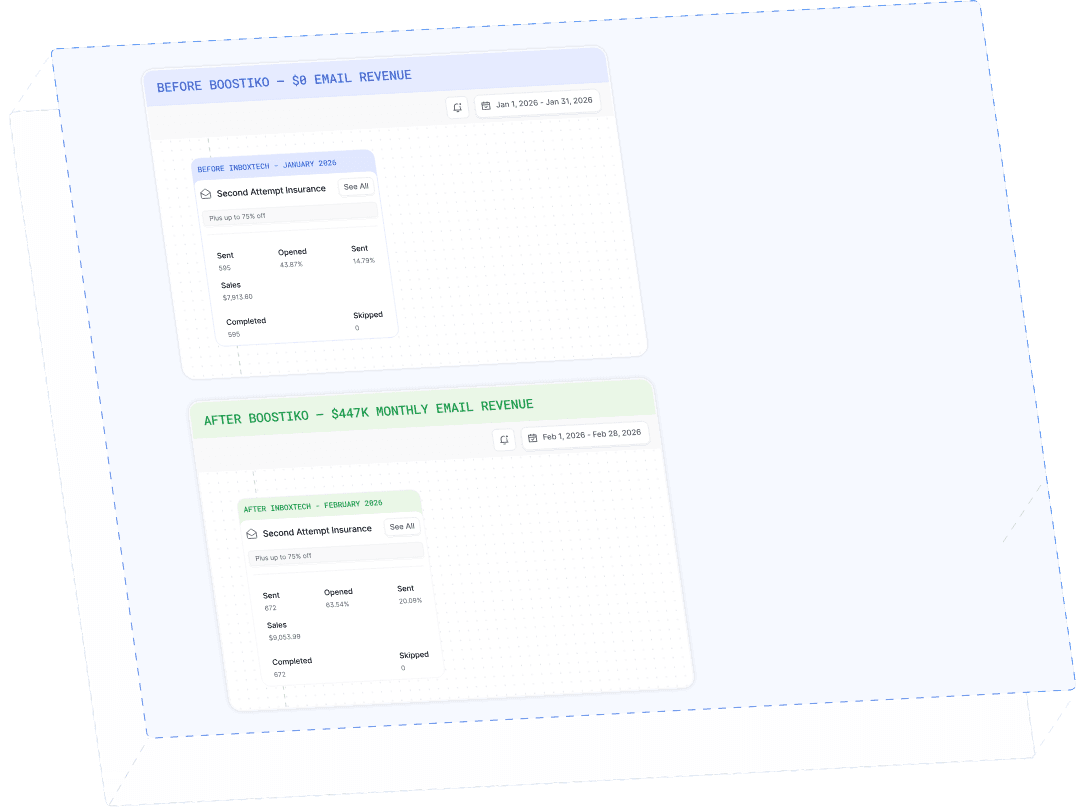
Case Study 01
Leading Prop Firm
$0 - $447K in 3 months
40.7% of total revenue
14 days time to first revenue
$0 to $447,115/month in Added Revenue in 90 Days