•
Boostiko Team

A trader buys an evaluation. The receipt arrives, followed by another discount. Meanwhile, they are unsure which platform to use, how the daily loss limit works or where to get help. That is a gap in the customer experience, not a shortage of promotional emails.
Retention marketing for prop firms should help customers understand and use the service they already purchased. It connects onboarding, account updates, useful education and support. Promotions have a place, but they should not turn account failure into a sales trigger or pressure traders into repeated speculative purchases.
Start with the customer’s next legitimate need. Then decide whether email is the right way to meet it.
What a complete retention system can produce
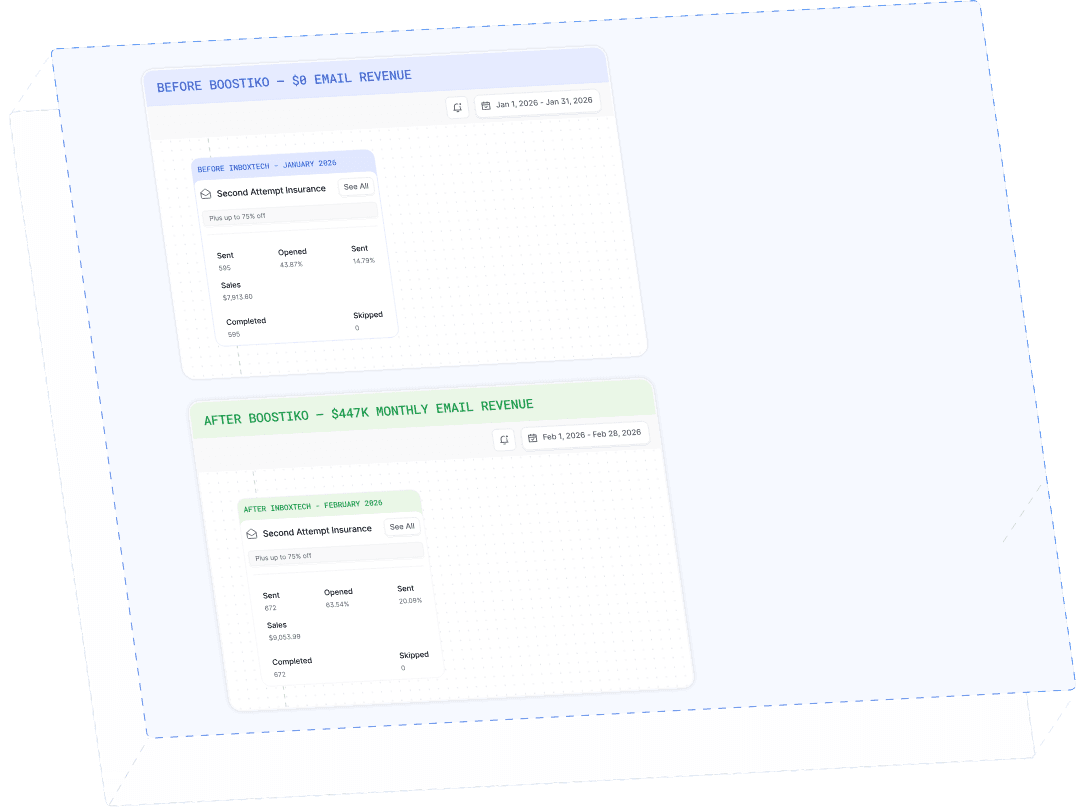
In our published prop firm case study, we took attributed email revenue from $0 to $447,115 a month in three months. The April dashboard shows email accounting for 40.70% of total revenue.7 The firm already had a list. The opportunity was turning that audience into a working lifecycle system.
We combined automated flows, lead capture, segmented campaigns and deliverability work. Our homepage describes more than seven automated flows, a website popup, weekly campaigns, InboxTech™ and community lead capture as part of that implementation.6 It was a coordinated retention program, not one discount email.
That is one client result measured through email attribution, not a promised outcome or proof that every attributed sale was incremental. The practical takeaway is to connect the whole journey before judging retention by the next campaign’s opens.
Make the first purchase easier to use
Build onboarding around confirmed events rather than a generic sequence sent to everyone. Klaviyo’s official post purchase guidance uses purchase events, conditional splits and timing controls. It also recommends checking for overlap with other flows so customers do not receive too many messages.1
For a prop firm, the purchase should start a clear handoff: confirmation, account provision, platform access and the correct rules for that product. Do not send “your account is ready” before the account system confirms it.
The first onboarding message should answer three questions: what has been purchased, what happens next and where to get help. Once access is ready, show the customer how to sign in and find their account information. Link to the dashboard rather than putting sensitive credentials in a marketing template.
If setup remains incomplete, offer practical help. Stop the reminder when setup is complete. Give returning customers a shorter route instead of repeating instructions they already know.
Teach the rules before confusion becomes a ticket
Rules education should explain the purchased account, not sell another one. Cover the daily loss calculation, drawdown model, permitted trading activity and any relevant payout conditions. Use the firm’s actual definitions and a reviewed example rather than borrowing rules from another provider.
Attach a product identifier and rules version to the customer record. A message about one evaluation model should not reach someone on a different model. When terms change, explain what changed, when it applies and which accounts are affected.
Keep these messages factual. “Here is how to check your current limit” is more useful than a motivational push to trade. Education should reduce ambiguity without promising that following an email will produce trading success. Have the team responsible for account rules approve the content before it becomes an automated flow.
Segment by account state, not just purchase history
Prop firm retention marketing needs a current picture of the account. Useful states include awaiting access, onboarding incomplete, active evaluation, verification pending, funded, payout review, paused and closed. Define those states with operations before building campaigns.
Use account events from the customer platform as the source of truth. Store the event time and account identifier. A trader can hold multiple accounts, so one account closing must not incorrectly mark their whole customer profile as inactive.
Each state needs an entry condition, an exit condition and an exclusion rule. An access reminder ends when access is confirmed. An account review notice replaces a generic engagement message. A rules breach should prompt a clear explanation and a support route, not an automatic discount for another evaluation.
For the implementation detail, use our prop firm email segmentation guide. The aim is relevant communication, not more segments for their own sake.
Give every campaign a purpose
Before approving a campaign, write down the audience, the useful action and who should not receive it. A platform walkthrough can help customers with incomplete setup. A factual payout checklist can help eligible customers prepare the required information. Neither needs a discount.
If you run a promotion, keep it separate from operational notices. Exclude customers with unresolved access problems, refund requests or complaints until the issue is handled. Use a shared frequency limit across campaigns and automated marketing flows so several teams do not send competing messages on the same day.
A campaign should earn its place in the calendar. “We have not emailed this week” is not a customer need.
Separate service mail from marketing permission
Do not assume that purchase creates blanket permission for promotions. Under UK ICO guidance, nonpromotional administrative messages can be service messages. Adding promotional content can make the message direct marketing, even when its main purpose is account administration.2 A discount attached to an access notice is not just a harmless footer.
The ICO says unsolicited email marketing to individual subscribers normally requires consent, with a limited products and services soft opt in where all its conditions are met.3 Apply the rules relevant to your audience rather than treating UK guidance as a global mandate.
Keep permission records and marketing suppression separate from account status. Respect unsubscribes, complaints and invalid addresses across every marketing flow. Preserve necessary account communications through an appropriate service channel without using that channel to restart promotions. Our prop firm email suppression guide covers those controls.
Check the sending setup too. Google and Yahoo publish authentication and easy unsubscribe requirements for applicable senders, including requirements for bulk marketing mail.4 5 These support responsible delivery; they do not determine whether a campaign is useful.
Connect email to a real support response
A help link should lead somewhere that can resolve the problem. Give onboarding replies an owner, pass the account context to support and make escalation clear. If customers keep asking the same rules question, improve the explanation instead of sending another reminder.
Use support status to pause inappropriate marketing. An unresolved payout query or access complaint deserves attention before a sales message. Resume eligible marketing only after the case is resolved and the customer’s permissions still allow it. Keep sensitive case details out of campaign personalization.
Measure retained value, not opens
Choose a retention outcome before launching the flow. That might be completed setup followed by continued legitimate account use over a defined period. Specify what “active” means for the product. Do not equate retention with trading more often or buying more evaluations.
For marketing tests, randomly assign eligible customers to a treatment group and a holdout that does not receive the tested marketing. Both groups should still receive necessary service messages and normal support. Compare outcomes over the same observation window, using all assigned customers rather than only those who clicked.
Measure the difference in retained customer rate and net receipts per assigned customer after refunds and chargebacks. Report campaign costs separately so incremental receipts are not mistaken for profit. Allow enough time for refunds to appear.
Track complaints, unsubscribes and support demand alongside the commercial result. Opens and clicks can help diagnose a message, but they are not proof of incremental retention. A campaign that increases purchases while increasing refunds or unresolved complaints needs a different conclusion.
Build one team around the lifecycle
Boostiko brings designers, copywriters, operations, technical implementation and deliverability specialists together as a retention marketing agency for prop firms. Instead of coordinating separate hires, you can work with one team to map account states, build useful flows and connect campaigns to support and measurement.
That work includes InboxTech™, Boostiko’s proprietary software built to improve deliverability and help managed emails reach Gmail Primary rather than Spam or Promotions. Our published InboxTech figures report a 44.8% open rate lift and a 35.8% click rate lift.6 Those are engagement lifts, not percentages of emails reaching the inbox. The software works alongside authentication checks, delivery monitoring, content review and list quality work. Gmail still decides placement for each recipient.
Talk to Boostiko about the first lifecycle gap to fix: access, rules education, state based messaging or measurement. Build a program that helps customers use what they bought before asking them to buy again.
References
Continue reading



Case Study 01
Leading Prop Firm
$0 - $447K in 3 months
40.7% of total revenue
14 days time to first revenue
$0 to $447,115/month in Added Revenue in 90 Days