•
Boostiko Team

Prop Firm Abandoned Checkout Emails: Answer Questions Before Offering Discounts
A trader selects an evaluation, enters an email address and leaves before paying. The obvious response is a reminder with a coupon. But the buyer may not be waiting for a lower price. They may be trying to understand what the fee buys, how a rule works or whether their preferred platform is supported.
Good prop firm abandoned checkout emails make those questions easier to answer. They return the buyer to the right product with fewer uncertainties, rather than applying a discount to a decision they still do not understand.
Start with the questions your support team already hears. Then build a small, accurate recovery sequence around the selected evaluation.
Find the questions behind hesitation
Checkout activity tells you where someone stopped, not why. A Started Checkout event does not prove a payment failed or that the price was too high. Klaviyo distinguishes checkout activity from cart activity and completed orders, so confirm what your integration actually records before interpreting it. 1
Review recent support conversations, checkout replies and common presale questions. Group them without copying names, account details or payment information into your working document. Useful groups include what the purchase provides, evaluation rules, platform access, fees and refund conditions.
For each question, record the product it concerns, the buyer's wording, the approved answer and the page where that answer belongs. A question about a specific drawdown calculation needs a different response from “Can I use this platform?” Keep the original wording so the email sounds like an answer to a person, not a policy summary.
Rank questions by how often they appear and how much misunderstanding they could cause. Frequency is a starting point, not proof of an abandonment reason. Ask support to tag recovery replies for a few weeks, then compare those replies with your initial question bank.
If the same question keeps appearing, fix the product page or checkout too. Email should help buyers, not compensate forever for missing information.
Build answers for the selected plan
Create an approved information record for each evaluation and version. Include the displayed price and currency, what the payment purchases, any applicable recurring charges, platform requirements, rule links and actual refund conditions. Assign an owner and review date to each record.
The distinction between a simulated evaluation and live account access must be clear. If the purchase is a simulated evaluation, say so. Do not describe the checkout fee as buying live funding or imply that passing, funding or payouts are guaranteed.
Give copywriters a short approved answer as well as the full source page. For example, a platform answer should name the supported option for that plan and explain any setup requirement. A refund answer should point to the applicable conditions, not promise flexibility the firm has not approved.
Use the product identifier from checkout to select this information. Do not send a general FAQ that blends rules from different evaluations. If the system cannot identify the plan reliably, use a neutral invitation to ask a question instead of guessing.
When a plan changes, the product owner should update the record, alert the email owner and test affected messages. If an older checkout cannot be restored under its original terms, explain the change on the return page before asking the buyer to continue.
Make the first email useful without a coupon
Choose one question that applies broadly to the selected product. Put the answer near the top, followed by one clear next step. The email does not need to reproduce the entire rulebook.
Consider this hypothetical example for a firm selling a simulated evaluation. It illustrates copy structure, not a client campaign or a message being sent:
Subject: What your evaluation purchase includes
You started checkout for a simulated evaluation. The fee purchases access to that evaluation, not a live trading account. Any later stage has its own requirements.
Before continuing, you can review the selected plan, current price and rules in your checkout. If something is unclear, reply with your question.
Button: Review my evaluation
The production version should use verified details for the selected plan. Keep the subject factual. “Payment problem” is inappropriate unless a reliable payment event actually recorded one. A calm explanation can be more useful than a large promotional headline when the buyer is deciding whether the product fits.
Use the second email to invite a real answer
The next message should offer a different kind of help, not repeat the first email with more urgency. Invite a reply about a specific area where buyers commonly need clarification.
For the same hypothetical firm, a second illustrative email could read:
Subject: Any questions about your selected evaluation?
If you are still considering this evaluation, what would help you decide? You can reply with a question about the rules, platform access or the purchase terms.
Our team can explain the published details for your selected plan. There is no need to complete checkout before asking.
Reply with your question.
Route replies to someone who can answer using the approved product record. Assign an owner and a realistic response target. If a buyer raises a product misunderstanding, resolve it before restarting promotional reminders.
As a pilot, consider a first message about four hours after checkout and a follow up the next day. This is a proposed test, not a proven prop firm schedule. Check event sync delays first, and end the sequence after a defined window. Klaviyo's ecommerce timing guidance is a starting reference, not evidence of the best timing for your buyers. 1
Make the return journey match the current state
A useful answer loses value if its button opens the wrong checkout. Test the return link against the selected plan, platform option, price and checkout expiry. A custom prop firm checkout needs documented restore behavior built for that integration. Do not paste a Shopify recovery variable into a different system and assume it works. 1
Use a secure restore mechanism without exposing personal information or sensitive credentials in the URL. When the buyer returns, the destination should check the current state. An unpaid, valid checkout can resume. A completed order should show confirmation or account access instead of requesting another payment. An expired or changed checkout should explain what needs reviewing.
In Klaviyo, the standard flow filter is “Person has Placed Order zero times since starting this flow.” Profile filters are checked again before each message. Verify that your order integration supplies Placed Order reliably, then test a purchase made between the two emails. 1
Also define what happens after a marketing permission change or a support conversation that should pause reminders. Choose one owner for recovery sends and disable overlapping native messages. The buyer should not receive another nudge while someone is answering their question.
Keep permission and delivery practical
Treat an unfinished purchase reminder as marketing, not a receipt. In the United States, CAN-SPAM requires truthful sender information and subjects, advertising disclosure, a postal address and a clear opt out, among other obligations. It is not a universal opt in law. A checkout email address is not universal marketing permission either. Apply relevant laws and platform requirements, record the permission you rely on and respect suppression changes. 2
Keep recovery messages separate from purchase receipts. Follow Gmail's sender requirements for authentication and unsubscribe handling, including the bulk sender requirements where applicable. Authentication helps establish a legitimate sender, but it does not guarantee inbox placement. 3
These checks should support a useful message. They are not a substitute for accurate product answers.
Offer a discount only when it addresses the remaining issue
If replies show that buyers understand the evaluation but find the price difficult, an approved offer may be worth testing. Do not assume that every silent buyer has the same objection.
Keep the first reminder focused on the product. Klaviyo warns that offering a coupon immediately can encourage customers to wait for discounts. That is a reason to test carefully, not a claim that every audience behaves identically. 1
Any later offer should have genuine eligibility, valid terms and an accurate price at checkout. Explain applicable exclusions or expiry without manufacturing urgency. Do not promise improved trading results because the buyer purchases now.
Compare a question led sequence with the same sequence plus an approved later offer. Change as little else as possible so the results help you decide whether the discount adds value.
Measure purchases and unresolved questions
Use actual order records as the basis for revenue reporting. Connect recovery activity to completed purchases, then account for refunds and discounts. If your starting figure is already net of discounts, do not subtract them again. Gross attributed revenue alone can make an expensive coupon sequence look stronger than it is.
Track replies, resolved questions and recurring misunderstandings alongside sales. More purchases accompanied by repeated confusion about what buyers bought are a signal to review the copy and checkout information.
Use Boostiko's guide to prop firm email revenue reporting to separate reporting choices from business results. Attribution credits a message under a chosen rule. It does not prove the email caused the purchase. If eligible volume is sufficient, a holdout group can help estimate incremental impact.
After purchase, move the buyer into the appropriate onboarding journey. The first challenge email sequence should reinforce the same product details, rather than introduce a different explanation of the evaluation.
Where Boostiko fits
Question led recovery needs cooperation between support, product owners, copywriters, designers and the people maintaining checkout events. Support supplies real questions. Product owners approve answers. Copy and design make them easy to understand. Technical and email operations teams keep the selected plan, restore journey, suppression rules and reporting aligned.
Boostiko brings those pieces together as an integrated email team, including deliverability work. The aim is a recovery journey that helps buyers make an informed purchase without relying on a coupon to do every job.
Talk to Boostiko about turning your checkout questions into clear, useful emails and a return path that matches what you actually sell.
References
Continue reading



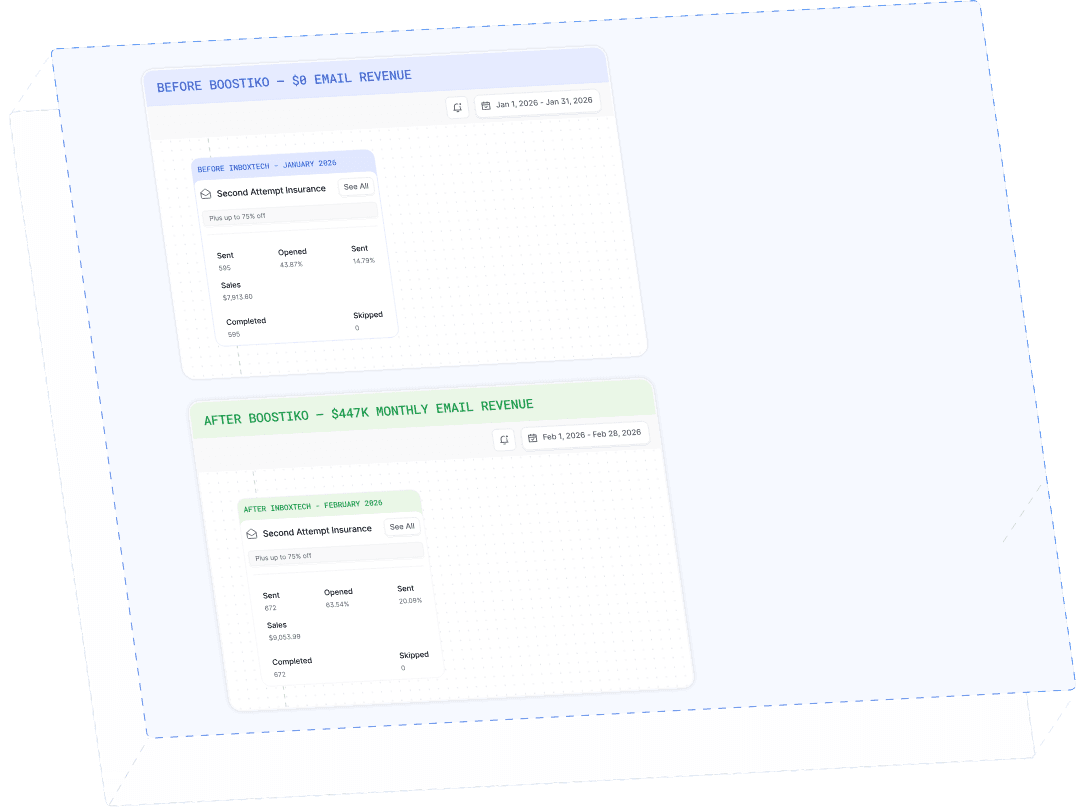
Case Study 01
Leading Prop Firm
$0 - $447K in 3 months
40.7% of total revenue
14 days time to first revenue
$0 to $447,115/month in Added Revenue in 90 Days