•
Boostiko Team

Prop Firm Email Revenue Reporting: Track Challenge Sales Without Inflated Credit
Your email dashboard shows challenge sales. Your payment records show money collected. Those figures can disagree without either system being broken.
A campaign may receive credit for a purchase a trader already planned to make. A refunded order may remain in a gross revenue total. A payment retry may accidentally create a second purchase event.
Useful prop firm email marketing reports make those differences visible. They connect campaign credit to verified challenge fee payments, show adjustments separately, and stop short of claiming every attributed sale was additional business.
Here is how to build email revenue reporting that helps you decide what to send, fix, or stop.
Separate attributed revenue from additional revenue
Attributed revenue is credit assigned under a reporting rule. Additional revenue is business that would not have happened without the marketing. They answer different questions.
Klaviyo assigns message conversion credit using recorded events, configured interaction windows, and interaction rules. Changing those settings can change which message receives credit. Its answer can also differ from Google Analytics because the systems apply different rules. Check your account configuration rather than assuming a universal attribution window. 1
A trader who clicks a promotion and buys a challenge can count as an attributed conversion. That record does not establish whether the trader needed the promotion to buy.
Keep attribution useful by documenting the purchase event, eligible interactions, window length, and how competing channels receive credit. Put a short version beside the revenue figure so nobody mistakes a model output for a causal result.
Do not add email-attributed revenue to paid-social-attributed revenue and call the sum total sales. Both platforms may claim the same order. Your payment ledger supplies the total; channel reports explain how different models allocate credit.
Start with successful payments and immutable IDs
The purchase event should represent a successful payment accepted by your payment system, not a checkout visit, payment attempt, or button click.
Define the qualifying payment status with your developer and finance owner. Send the event when that status is confirmed server-side. A browser thank-you page alone is a weak source because a trader can reload it or leave before it loads.
Use an immutable order ID to join the purchase event to the order record. Preserve the payment transaction ID too, especially where one order can have multiple attempts. Decide how installments or multiple captures relate to the order before reporting them.
Your integration also needs deduplication. A repeated webhook delivery must not become another sale. Use a stable event identifier and an idempotent ingestion process, then check whether the destination deduplicates on the field you actually send.
A useful purchase record includes the order ID, payment ID, successful payment time, amount, currency, product category, and an internal customer identifier. Keep campaign and attribution fields available without treating them as proof of payment.
Reconcile purchase events against accepted payments regularly. Investigate missing orders and duplicates before optimizing the campaign credited with them. Better subject lines cannot repair a sales feed that counts the same payment twice.
Keep challenge fees, products, and adjustments separate
For this report, revenue means fees collected from selling challenges and related products. It does not mean a trader's trading profit, funded account balance, or payout.
Keep trader payouts in the appropriate financial report. Mixing them with challenge purchases makes both marketing performance and business economics harder to understand.
Separate purchase categories at the event level:
Initial challenge or evaluation fees.
Renewals or recurring fees.
Reset fees.
Add-ons attached to a challenge or account.
An existing trader buying a reset is not a new customer acquisition. A renewal is not a fresh evaluation sale. Category-level reporting prevents those differences from disappearing inside one attractive total.
Maintain a separate adjustment ledger for refunds and chargebacks. Each entry should reference the original order or transaction, identify the adjustment type, and record the amount, currency, and effective date. Support partial refunds rather than treating every refunded order as fully reversed.
Keep cancellations separate from completed refunds. A canceled renewal may prevent a future payment without reversing money already collected.
Do not assume your email platform's default revenue figure is net of these adjustments. Present gross paid fees, refunds, chargebacks, and the resulting adjusted fee revenue explicitly. State whether processing fees, taxes, and other deductions are included. A campaign report is not automatically a complete profit statement.
Standardize tags and remove misleading engagement
Create one stable UTM convention for all promotional links. Google recommends using utm_source, utm_medium, and utm_campaign; utm_content can distinguish creative or links. Values are case sensitive, so consistent lowercase naming prevents fragmented campaign records. 3
For example, use utm_source=boostiko_newsletter, utm_medium=email, utm_campaign=evaluation_november, and utm_content=primary_cta. Your labels can differ, but define them once and apply them consistently.
Never place names, email addresses, phone numbers, account credentials, or other personal information in tags. Keep customer identity in controlled internal records, not in URLs that can be copied or logged elsewhere.
UTMs identify campaign traffic. Google Analytics makes tagged traffic available through acquisition reporting, but a tagged visit is not evidence that the message caused the purchase. 3
Clean engagement reporting as well. Apple Mail Privacy Protection can produce machine opens, and Klaviyo provides settings to exclude them from relevant attribution. Verify those settings before using opens as evidence of purchase influence. 1
Security scanners and link previews can generate non-human clicks. Klaviyo includes a Bot Click flag and exclusion controls; custom reports may still require a Bot Click=false filter. No classifier should be treated as perfect. 2
A bot does not buy a challenge, but its click can distort which message receives credit for a later real purchase. Prioritize verified orders and filtered clicks over headline open rates when evaluating commercial performance. 2
Compare mature cohorts on common terms
Group comparable sends and customers before judging performance. Keep new prospects separate from existing traders, and avoid comparing a reset campaign with a first-challenge welcome sequence as if they serve the same purpose.
Your prop firm email segmentation guide can help define those audiences. Record the eligible audience at send time so later customer-status changes do not silently rewrite the cohort.
Use one reporting timezone for campaign delivery, successful payments, and adjustments. Preserve original timestamps so transactions near midnight can be traced.
Keep original currencies in the ledger. If you also report a consolidated currency, document the exchange-rate source and conversion date. Do not sum unlike currencies or compare converted figures produced under different policies.
Label recent campaign results provisional. Allow the configured conversion window to mature before comparing sends, as later purchases can still receive message credit. 1
Refunds and disputes may arrive after that window. Distinguish a campaign-cohort view, which updates the original cohort with later adjustments, from a calendar-period view, which shows adjustments recorded this week. Both are useful; they should not carry the same label.
Give founders a weekly decision report
A weekly report should answer three questions: what was collected, what email received credit for, and what action follows?
Start with verified gross challenge fees by purchase category. Show refunds, chargebacks, and adjusted fee revenue separately. Include unique paid orders and new buyers so a repeat purchaser cannot quietly become another acquired customer.
Then show attributed revenue under the documented model, with mature and provisional campaigns clearly separated. Note reconciliation gaps, unusual adjustments, bot-filter changes, and changes to attribution settings. These are explanations for the numbers, not footnotes to hide.
Finish with a few decisions. Perhaps a sequence needs clearer reset eligibility, an offer attracts purchases that are later refunded, or checkout payments succeed without reaching the email platform. Assign each issue to the person who can resolve it.
Consider a qualitative example. A trader clicks a renewal reminder, buys a renewal, and later receives a partial refund. A security scanner also clicks an earlier promotional email.
The ledger records one successful renewal payment and a linked partial refund. The renewal remains a repeat-customer purchase, not a new challenge buyer. The attributed view uses the configured rules with bot exclusions applied. The report still cannot say the reminder created demand that would otherwise have been absent.
That is useful information: the payment is real, its category is clear, and its campaign credit has limits.
Keep operational messages distinct. Payout update emails support trader communication; their importance should not depend on receiving challenge sales credit.
Test additional revenue cautiously
If you need evidence of additional revenue, consider a randomized marketing holdout. Eligible traders are randomly assigned either to receive a promotional campaign or to a comparable group that does not receive that promotion.
Plan the test before sending. Define the eligible population, outcome, observation period, and how other promotions will be handled. Compare verified purchases and adjusted fee revenue, not just clicks or attributed totals.
Only attempt this with enough volume to support a useful conclusion. Small audiences and infrequent purchases can produce inconclusive results. Get help with test sizing and interpretation rather than turning a noisy difference into a revenue claim.
Never withhold important account, payment, security, or other operational alerts. Exclude essential communications from the experiment. A holdout is a controlled marketing test, not a reason to leave traders uninformed.
Where Boostiko fits
Clean reporting connects the message, design, tracking, payment events, and delivery setup. Those pieces need to work together before the dashboard becomes useful.
Boostiko brings copy, design, technical implementation, campaign operations, and deliverability into one coordinated service. Instead of hiring separate people for each piece and managing every handoff, your team gets connected execution across prop firm email marketing.
The goal is clearer communication and reporting you can use, not a promised revenue lift or guaranteed return. If your campaigns and payment records tell different stories, talk to Boostiko about connecting them.
FAQs
Is email-attributed revenue additional revenue?
No. It is purchase credit assigned under a model. Estimating additional revenue requires a credible comparison with what would have happened without the promotion.
Should refunds reduce campaign revenue?
Show gross revenue and linked adjustments separately, then report the adjusted figure. Explain whether adjustments follow the original campaign cohort or the period when they occurred.
Can we report sales from checkout events?
Use checkout events to diagnose intent and friction. Count revenue only after the qualifying successful payment is confirmed, with stable IDs preventing duplicate sales.
References
Continue reading



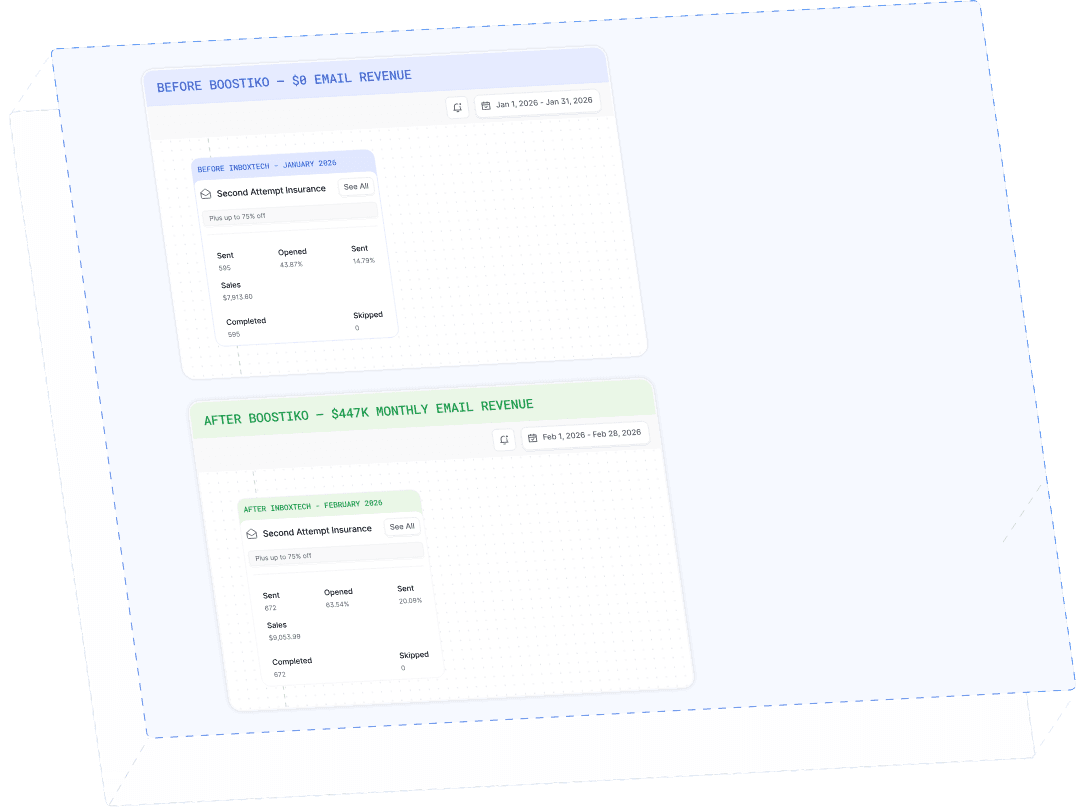
Case Study 01
Leading Prop Firm
$0 - $447K in 3 months
40.7% of total revenue
14 days time to first revenue
$0 to $447,115/month in Added Revenue in 90 Days