•
Boostiko Team

A trader tells support that their evaluation account shows the wrong rules. While an agent investigates, an automated email invites them to buy another evaluation. Support knows why that offer is inappropriate. Marketing only sees a customer who qualifies for the next flow step.
The missing connection is a usable handoff. Prop firm email marketing needs a way to pass the issue, its scope and the next decision between teams. A ticket number alone cannot tell a campaign manager what to pause or who can approve a restart.
Our guide to retention marketing for prop firms covers the wider customer journey. Here, the focus is the working agreement between support and marketing when that journey goes wrong.
Pass a decision record, not the whole conversation
Support should keep the detailed conversation in the helpdesk. Marketing needs enough verified context to avoid conflicting messages, not a copy of every complaint, screenshot or identity document.
Agree on a small handoff record:
A verified customer identifier and the affected account or product identifier.
The ticket reference, issue category and current status.
The marketing hold reason and the campaigns or flows it covers.
The support owner, review owner and next review time.
The last status update and a short, factual communication note.
A useful note might say: “Account rules mismatch under review. Do not send evaluation upgrade offers. Support has promised an update after account operations checks the configuration.” It should not label the trader as difficult or predict whether they will buy again.
These are proposed integration fields, not a claim that every email platform provides a native support connector. Resolve the customer identity before applying a hold. If the match is uncertain, send the case for review rather than changing another customer's marketing state.
Decide which messages the ticket affects
Not every ticket requires a global pause. A routine invoice question may leave unrelated marketing eligible. An unresolved access problem may justify holding evaluation promotions. A complaint about repeated sales messages may require a broader review of the customer's preferences and current campaigns.
Define these choices with support before launch. The hold should name the affected audience or message purpose, not merely say “ticket open.” Support can escalate an unusual case rather than forcing it into the nearest category.
Keep permission restrictions separate from temporary case decisions. Our prop firm email suppression guide covers those baseline controls. A support hold adds context; it does not replace them.
Apply the decision to scheduled campaigns as well as automated flows. Pausing a win-back sequence is incomplete if tomorrow's newsletter carries the same offer. For a widespread platform incident, the support lead can request a campaign-level pause for affected customers rather than relying only on individual tickets.
Give support and marketing different responsibilities
The support agent should own the factual case update and initiate a hold under the agreed policy. A support lead should own exceptions and confirm whether the customer issue has actually been addressed.
Marketing operations should own implementation across the named campaigns and flows. That includes checking scheduled sends, confirming the hold reached the sending platform and reporting failures back to support. Marketing should not clear a hold just because a launch deadline is approaching.
Assign one person to approve release under the policy. For routine cases, that might be the support lead; for disputes or security concerns, the relevant operations owner may also need to review. Record the approver and decision time.
The handoff should work both ways. Support needs visibility into the last relevant promotional message and the affected sequence. Otherwise, an agent may promise “no more offers while we investigate” without knowing another campaign is already scheduled.
Use workflow controls within their actual scope
HighLevel's Stop on Response removes a contact when they respond to a message from that specific workflow. It does not establish that a ticket opened elsewhere stops every promotional workflow. Allow Re-entry generally permits another entry after completion or manual removal, subject to trigger rules and documented exceptions. It is not approval to restart marketing after support closes a case.1
HighLevel also supports channel-specific DND settings. Its documentation says conflicting communication steps are skipped while other actions can continue. Email DND therefore should not be described as an automatic halt to every channel. Do not clear an existing opt-out to release a temporary support hold.2
In Klaviyo, metric-triggered flow trigger filters inspect entry-event data. Profile filters are checked at entry and before flow actions. A failed check can skip one action while leaving the person moving toward later steps.3
That matters when a hold clears during a delay. A later offer could become eligible without a new flow entry. Marketing must decide whether that later message remains appropriate. Syncing a reviewed hold field is useful, but it only works after the update reaches the platform.
Make resolution a reviewed event
Ticket closed is not marketing approved. A case may close because it was merged, duplicated or automatically archived. None of those states proves that the issue was resolved.
Use a separate reviewed resolution event for marketing decisions. It should identify the case, the verified outcome, the reviewer and the permitted next action. Check for other relevant open cases before releasing the hold. A reopened case should return to the defined review process.
The next action can be “remain paused,” “eligible for future campaigns” or “review a revised flow.” Do not automatically send all the offers missed during the investigation. A resolution note also should not become a disguised sales pitch.
Marketing opt-outs stay effective after resolution. The FTC explicitly says subscribers and members retain the right to opt out of marketing emails. Closing a ticket does not reverse that choice.4
A hypothetical account-rules handoff
Suppose a fictional prop firm receives a ticket about an evaluation displaying a different daily loss rule from the purchased product. The agent verifies the account, records the mismatch and requests a hold on evaluation promotions. No conclusion about trading performance or entitlement is assumed.
Marketing operations applies the hold to the relevant flow and the next evaluation campaign. Support continues the investigation and factual updates. Account operations later confirms the correction, and the support lead reviews the response before issuing the resolution event.
Marketing then checks permission and any remaining holds. If eligible, the customer can enter future relevant campaign audiences. The team does not restart an expired countdown or claim the corrected account will produce a profit.
Keep necessary notices available without adding offers
A promotional pause should not automatically stop essential operational communications. Requested access help, security notices and factual updates need a separately reviewed sending path, subject to applicable law and delivery restrictions. Do not manually remove an opt-out to force an email through.
UK ICO guidance distinguishes non-promotional service messages from direct marketing and warns that adding promotional elements can change the classification. US FTC guidance uses narrow transactional categories and a primary-purpose test for mixed messages. These are jurisdiction-specific rules, not interchangeable global standards.5 4
Keep those templates focused on the verified event. Our prop firm payout update email guide explains how to keep status communication separate from offers. Neither an internal label nor a support reply makes a promotion essential.
Boostiko builds campaigns and automated trader flows alongside CRM integrations. InboxTech™ is our proprietary in-house technology for email deliverability.6 These tools serve different jobs: the handoff decides whether a promotion should send; deliverability work supports legitimate messages reaching recipients. Neither ticket closure nor an inbox-placement goal overrides permission or guarantees placement.
For help connecting support decisions to campaigns and flows, contact Boostiko to review the handoff, ownership and release rules in your retention program.
References
Continue reading



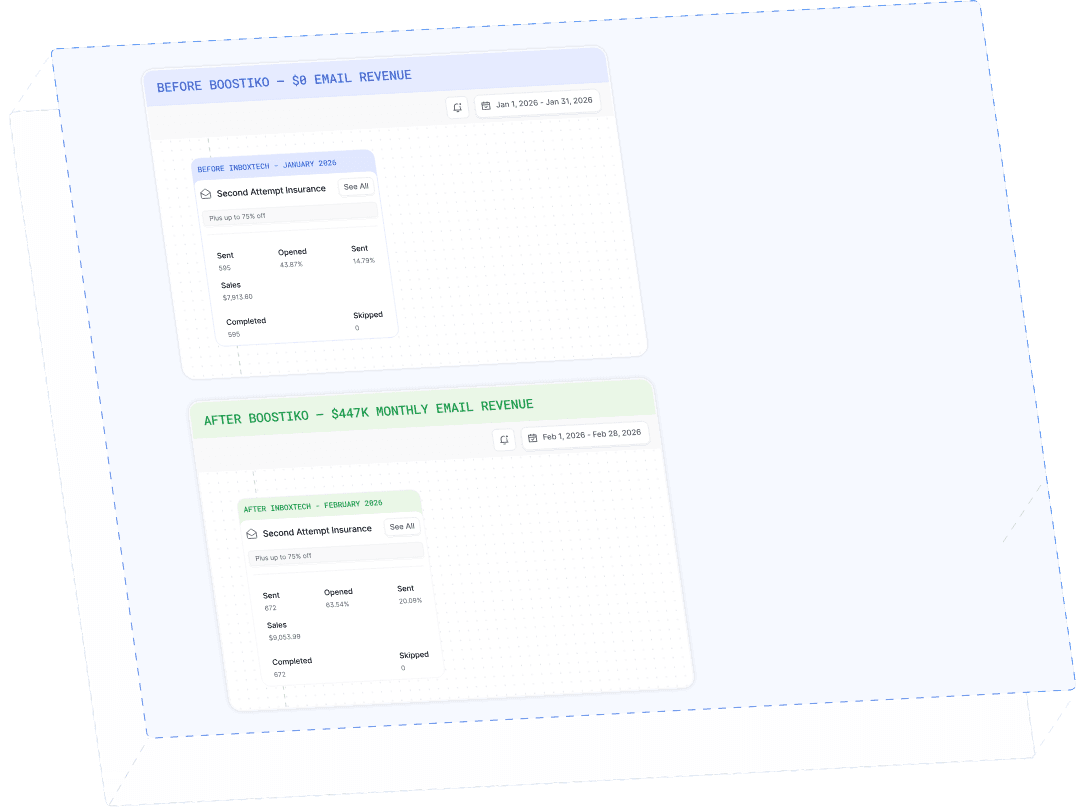
Case Study 01
Leading Prop Firm
$0 - $447K in 3 months
40.7% of total revenue
14 days time to first revenue
$0 to $447,115/month in Added Revenue in 90 Days