•
Boostiko Team

Your team releases a useful dashboard feature. The announcement gets clicks, but customers still ask support how to find it. Some received the email before the feature reached their account. Others already used it and keep getting reminders.
The announcement is working. The customer journey is not.
Retention marketing for Web3 prop firms should connect a product release to something a customer can actually understand or use. That requires more than a launch email. You need the right audience, a clear explanation and a way to stop messages when their job is done.
Here is a practical workflow for doing that without turning every update into an urgent campaign.
Start with the customer change, not the release notes
A developer's release note might describe a connector, interface or infrastructure change. The customer needs to know whether anything changes for their account.
Ask the product owner to explain the consequence in plain language. Can the customer find a report more easily? Does an existing setting move? Must a particular desktop client be updated? Or does everything continue working without action?
The Web3 label does not answer those questions. Do not assume every Web3 prop firm operates on chain, uses the same wallets or shares a trading model. Check the actual product and its dependencies.
For each release, confirm the affected product, the accounts with access, the rollout status and any relevant platform version. If the team cannot identify affected accounts, do not pretend a broad mailing list is precise targeting. Give customers a safe way to check whether the change applies.
A phased rollout also needs phased communication. An email should not invite someone to use a feature that is still unavailable in their account.
Decide whether action is required
Put each change into one of three groups: information only, an optional feature or a required action. That choice should shape the message and its reminders.
There is a useful example in the Ethereum Foundation's April 2025 Pectra announcement. Ordinary users of exchanges and wallets generally did not need to do anything unless their provider instructed otherwise. Node operators, however, needed compatible execution and consensus clients. The same upgrade had different instructions for different roles. This is a past example, not an upcoming upgrade notice. 1
Apply that distinction to your own release. If no customer action is needed, say so after the product owner confirms it. Do not create an activation task for an invisible technical improvement.
If the feature is optional, explain its purpose and let the customer choose. If an action is necessary, identify who must complete it and provide the approved steps. Only state a deadline or consequence when both are confirmed.
A subject line such as "New reporting view available in your dashboard" fits an optional feature. "Update required for desktop client version X" belongs only to the customers using that affected version. Neither needs a vague warning that their account is at risk.
Build a short walkthrough for the affected platform
The first email should help someone complete the real task. It should not make them search through a long release announcement to find the instructions.
Show where the control lives, what happens when they use it and how to recognise a successful result. Use the names that appear in the actual interface. Check the steps on the platform and version the audience uses.
For example, imagine a firm releases an optional dashboard reporting view. Its message could explain where to find the view and whether it changes any existing account information. The screenshot should show that view, not a generic trading screen. This is an illustrative release, not a claim about a live firm's product.
A simple optional feature notice could read:
A new reporting view is available in your dashboard. You can find it under Reports when you next sign in. Using it is optional. Your current account settings are unchanged. The guide in your dashboard explains how the view works, and support can help if it is not visible.
Every statement in that example needs product confirmation before use. If the view is not available to all accounts, narrow the audience or state the eligibility clearly.
Use the email for the explanation and the known account area for the action. A community post can point to the same guide. It should not introduce different steps or promise access that the dashboard cannot provide. Our Web3 prop firm email operations guide covers broader channel coordination.
Keep wallet instructions specific and verifiable
A genuine product update should not resemble an unexpected request to validate a wallet or reveal credentials.
MetaMask says it will never email customers to ask for their password, Google or Apple account details, or Secret Recovery Phrase. Its guidance also identifies legitimate email categories, including requested support correspondence and subscribed marketing updates. The rule is not that MetaMask never sends email. It is that a credential request is not a legitimate MetaMask instruction. 2
If your release involves a wallet, have the technical owner verify the exact dependency and approved process. Do not invent a wallet migration simply to give a campaign a stronger call to action. Do not ask people to reply with recovery phrases or passwords.
Give customers a route through the known dashboard or official provider documentation. Explain what the genuine action does. A real connection or update should be described accurately, not hidden behind "verify now" language.
For more detailed template guidance, read our article on Web3 prop firm wallet emails.
Classify feature adoption messages honestly
An email encouraging use of a new feature is not automatically an administrative notice because the feature is free.
The UK ICO says a service message with direct marketing elements counts as direct marketing. It also says actively encouraging people to use a service, offer or upgrade is likely to be direct marketing. Calling it a product update does not settle the classification. These are UK rules; review the audience and applicable requirements in other markets separately. 3
Keep factual account notices separate from optional adoption campaigns. Apply the appropriate permissions, subscription preferences and unsubscribe controls to marketing. Do not add an upgrade offer to a required maintenance notice and assume the whole email is still operational.
The distinction matters for sending setup too. Google's guidance for personal Gmail accounts requires sender authentication. Where its bulk sender requirements apply, marketing and subscribed messages need one click unsubscribe and a visible unsubscribe link in the body. Those are Gmail requirements, not a promise that a message will reach a particular inbox folder. 4
Make reminders check the product state again
A reminder should ask the product system whether the original instruction is still relevant.
Before each send, check that the account has access to the release and still needs the action. Stop reminders after confirmed completion. Cancel them when a release is paused, rolled back or replaced. If the feature becomes unavailable, do not send a queued email saying it is ready.
Keep a release reference with the audience and message rules so the team can stop the affected sequence without disabling unrelated communication.
If you cannot observe completion, an email click does not solve that gap. It only proves that someone followed a link. Use an honest confirmation or support route instead of treating the click as a completed update.
Test these cases before launch: an eligible account, an account outside the rollout, an account that already completed the action and a release that has been paused. Our Web3 prop firm email automation testing guide explains how to test the wider flow.
Measure product use separately from email engagement
Choose the result that matches the release.
For an optional reporting view, that could be successfully opening the view in the product. For a required client update, it could be confirmation that the affected account now uses a supported version. For information only, there may be no adoption task to measure at all.
Use eligible accounts with access as the starting group. Including customers who cannot use the feature makes the adoption report misleading.
Keep delivery, opens and clicks in a separate communication report. They help you understand whether the explanation reached people, but they do not prove that a feature was used or that retention improved.
Review support questions as well. If people repeatedly ask where the control is, fix the walkthrough. If the feature does not appear for eligible accounts, fix the rollout. Sending another announcement will not repair either issue.
Connect the release journey with Boostiko
A retention marketing agency for Web3 prop firms should help customers move from an accurate update to a useful next step. That means connecting product facts, audience rules, clear copy, readable design and reliable automation.
Boostiko builds that system with your team. You keep ownership of product behaviour, eligibility and compliance decisions. We turn the approved information into targeted campaigns and flows, test the customer route and maintain the sending setup.
InboxTech™, our proprietary software, supports our work to improve inbox placement, with a focus on Primary rather than Spam or Promotions. Boostiko's website reports a +44.8% open rate lift and a +35.8% click rate lift. These are published engagement figures, not inbox placement percentages, Web3 specific results or a forecast for your firm. Mailbox providers decide placement for each recipient. 5
The goal is a release journey that stays useful after the announcement: customers know what changed, see the right instructions and stop receiving reminders when they no longer need them.
Book a call with Boostiko to connect your product updates with a customer lifecycle your team can run reliably.
References
Continue reading



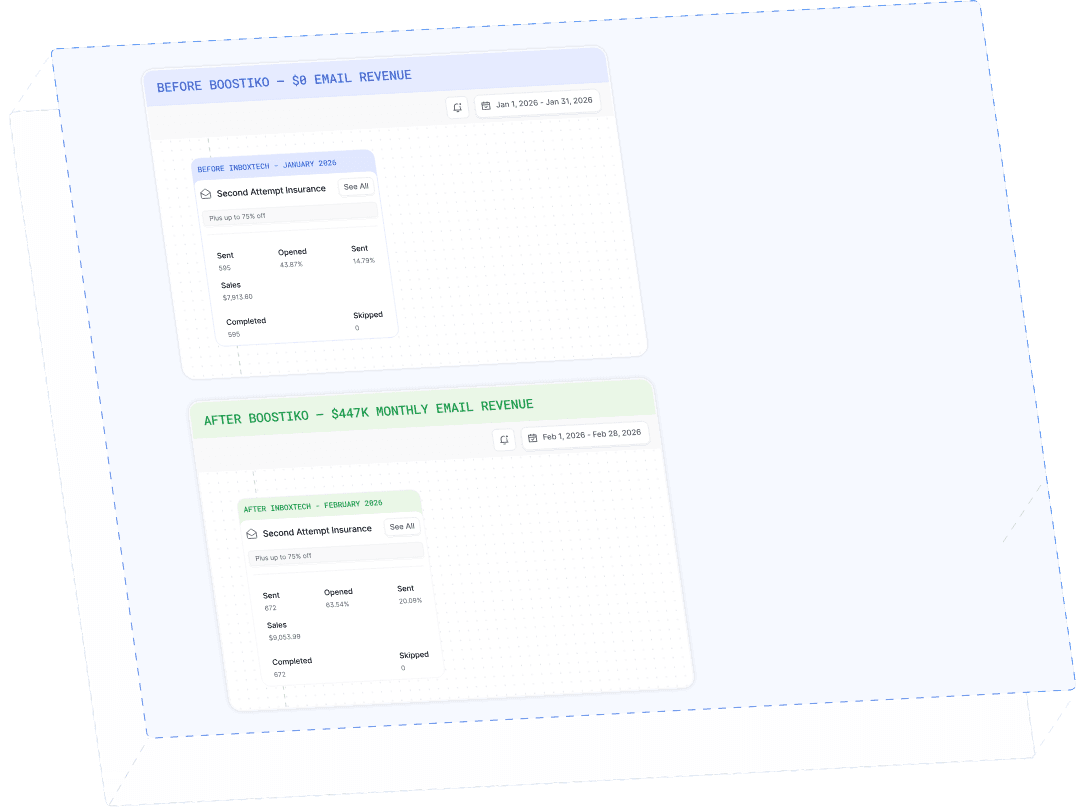
Case Study 01
Leading Prop Firm
$0 - $447K in 3 months
40.7% of total revenue
14 days time to first revenue
$0 to $447,115/month in Added Revenue in 90 Days